


On 13 May 2026, the Central Board of Secondary Education declared the Class 12 results.
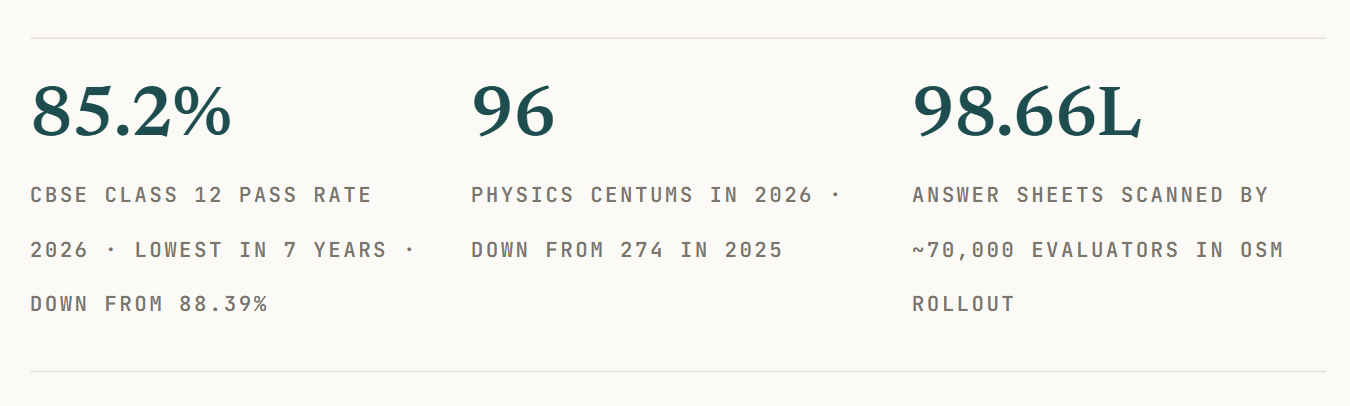
The national pass percentage came in at 85.2 percent. A year ago, it had been 88.39 percent. It was the lowest pass rate in seven years. In Physics alone, the number of students who scored a perfect 100 collapsed from 274 in 2025 to 96 in 2026. Parents and teachers asked the obvious question. Had an entire cohort suddenly become weaker at science in twelve months, or had something else changed?
The something else was the CBSE on-screen marking system, or OSM. For the first time at national scale, roughly 98.66 lakh answer sheets were scanned and evaluated digitally by around 70,000 evaluators. By the first week of June, the CBSE Chairman and Secretary had been removed. The reevaluation portal had been reopened. Fees had been slashed to 100 rupees per question. A 19-year-old ethical hacker had publicly demonstrated that the system's AWS configuration was leaking answer sheets. And the human face of what was being called one of the largest examination scandals in post-independence India was a 17-year-old Class 12 student who had paid for a photocopy of his Physics paper, only to find that the sheet uploaded as his was not his.
CBSE was right to move to digital evaluation
It is worth being honest before being critical. The paper-based system India was running, at a scale of nearly one crore answer sheets every cycle, was not working the way the public believed it was. Sheets went missing in transit. Totalling errors were routine. Marking varied not just by examiner but by mood, by fatigue, by the hour of the day. Students appealing wrong marks waited months. The volume of human verification required had become a tax the system could no longer pay. CBSE moving to OSM was not the wrong decision. The intent was correct. The direction was correct. The execution was where it broke.
What actually broke in the CBSE digital evaluation 2026 rollout
Here is the part the news cycle has largely missed. CBSE digitised the medium. It did not redesign the method. Scanning answer sheets and routing them to remote evaluators is not the same as building a digital evaluation system. The marking schemes did not change. The training did not deepen. The Delhi Government School Teachers' Association had publicly warned in February that the majority of teachers being asked to evaluate digitally had received no structured certification on the new system. They were given dry runs, instructional videos, and a call centre number. That is not training. That is being handed a new tool and asked to deliver national-stakes outcomes with it.
Then the board did one thing it should not have done. Ahead of the results, it announced that post-result verification of marks would be discontinued, citing the accuracy of the digital system as justification. That was the sentence that pre-loaded the controversy. CBSE removed the safety net before it had proven the system warranted removing it.

There is a global parallel here that explains why this keeps happening. A Microsoft Education survey this year found that 76 percent of education leaders believe their users have been trained on the digital tools deployed in their institutions, while only 45 percent of educators say they have received any training. That perception gap is where every digital evaluation system in India will quietly fail until it is closed.
What accurate digital grading at scale actually requires
Accurate digital grading at scale is not scan-and-route. It is at least four things working together. First, structured rubrics that live inside the evaluation interface, not as a PDF on the side, and that record the rationale behind each mark so variance can be detected when an evaluator's pattern drifts from the norm. Second, evaluator training treated as a software onboarding problem, not an HR formality. Hours of practice on graded sample papers, with feedback, before the evaluator's marks count for anything. Third, flagging systems for edge cases. Crossed-out answers. Answers continued on the back of the page. Diagrams that do not fit the scan window. Handwriting the OCR cannot read. Each is a category, not a footnote, and each one needs an escalation path. Fourth, multi-pass evaluation on a meaningful sample of papers. Not just statistical outliers, but a random blind sample of every evaluator's work. The point is not to catch the fraudulent evaluator. It is to catch the well-meaning evaluator whose calibration has quietly drifted by week three. CBSE built one of these well. The other three either did not exist or did not work at scale.
What we learned grading 12,000 government scripts in Abu Dhabi GradeLab spent most of last year on a project grading 12,000 scripts for Abu Dhabi government school exams. The single most useful thing we learned was unglamorous. The accuracy on the easy 98 percent of sheets was not the interesting number. The interesting number was how many sheets the system correctly refused to grade on its own. About two percent of the sheets had something the model could not handle with confidence. An answer continued on the back of the previous page with no marker. A diagram drawn over the printed question. A correct answer in a child's handwriting our OCR read as a different word. Each of these went to a human reviewer with a flag and a reason. The human did the call. The system learned from the resolution and the next batch held up better. The accuracy on the easy ninety-eight was not what made the deployment work. The discipline of refusing to grade the two was.
The two percent is the system This is the part that connects directly to what CBSE just lived through. The moment a digital evaluation system decides that one hundred percent of the sheets can be confidently graded, it has stopped being an evaluation system. It has become an averaging machine. And the cost of the two percent it should have flagged but did not is paid not by the system but by the seventeen-year-old whose Physics paper got the wrong evaluator on a Wednesday afternoon. The CBSE OSM controversy is not really a story about digitisation versus paper. It is a story about whether the digital system was given the right job. CBSE asked it to be faster, cheaper, and more transparent. All three are reasonable goals. What CBSE did not ask it to be was humble, in the specific technical sense of refusing to grade what it could not grade well. A system that has been told it does not need to defer to humans will not defer. And then the humans have to defer to it.
What students and teachers deserve from digital grading in India Which leaves the open question, and I think it matters more than the pass rate. What should a digital grading system actually give students that the paper one didn't?
The paper-based system did not give students transparency, speed, or consistency. The digital system was sold on all three. What it has not yet been asked to give them is the one thing only a digital system can. The audit trail. Every student should be able to see, by question, which rubric was applied, which evaluator marked it, which flags were raised, which were resolved, which were not. Not a photocopy of the sheet after the fact, paid for at seven hundred rupees per subject, with no way to read between the marks. The actual log.
CBSE has not built that yet. Neither has any other board operating at this scale. The next decade of education technology in India will be judged not by the launch claims and the accuracy press releases, but by whether the systems we build remember, every single time, who the work belongs to and what was done to it.



