


Beyond On-Screen Marking: How CBSE 2026 and GradeLab Are Architecting the Future of Assessment
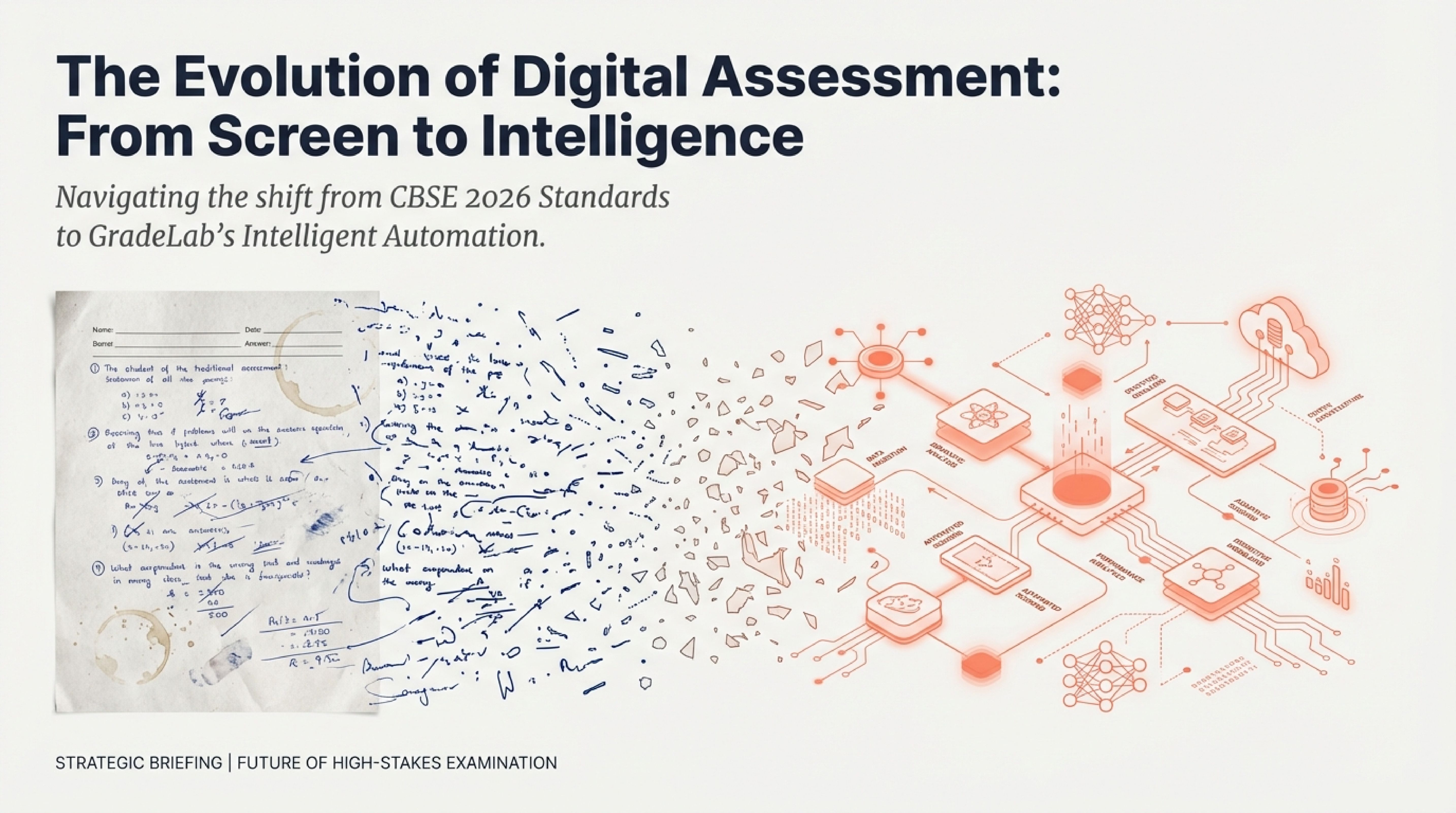
What happens when India's biggest school board stops moving paper? CBSE Class 12 hits On-Screen Marking in 2026. Answer booklets become scans. Examiners sit at screens instead of stacks. The logistics problem shrinks. But the person in the chair still does the full job: read, interpret, score. Every script. Nothing in the workflow actually shrinks the cognitive load. That's the bit most discussions skip. Intelligent automation doesn't just move the same work onto a display. It changes who does the work. One part of the picture is the end of the physical script as the unit of labour. The other is a stack that ingests data, runs an analytic engine, and does algorithmic grading inside secure infrastructure. This post is about that second part.
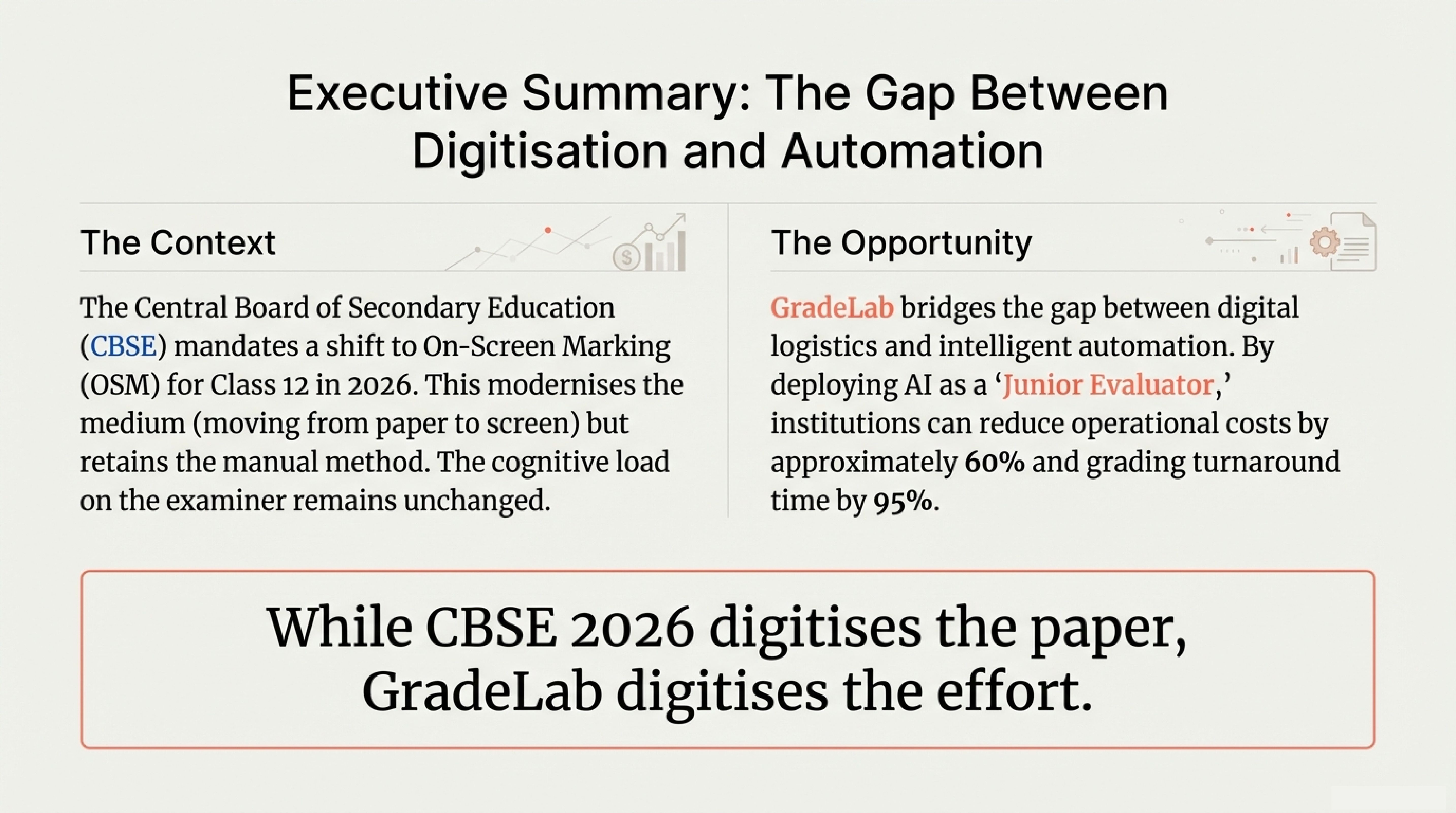
The line that sticks: CBSE 2026 digitises the paper. GradeLab digitises the effort. Same idea, different level. OSM upgrades the medium. The effort (who reads, who scores) stays on the teacher. GradeLab steps in with AI as a "Junior Evaluator." Their numbers: roughly 60% lower operational cost and 95% faster grading turnaround. How they hit those numbers comes next.
Why OSM Alone Doesn't Fix the Bottleneck
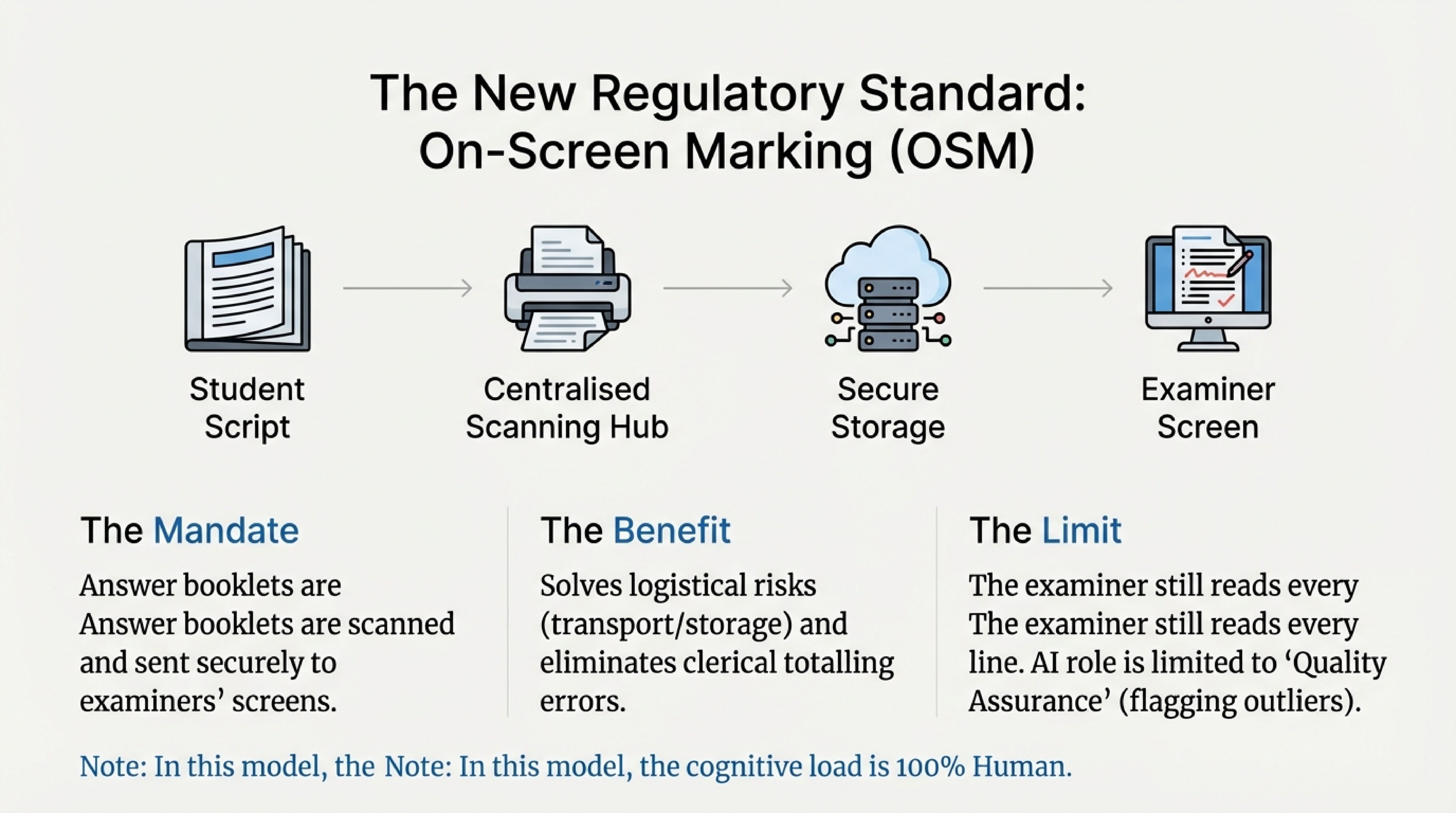
On-Screen Marking is a straight line: script leaves the student, hits a centralised scanning hub, lands in secure storage, then appears on the examiner's screen. Booklets are scanned and sent digitally. You drop a lot of transport and storage risk and you remove clerical totalling errors. Good. The limit: the examiner still reads every line. AI in this setup is confined to quality assurance, e.g. flagging outliers. Cognitive load stays 100% human. You've changed the channel. You haven't changed the volume of work.
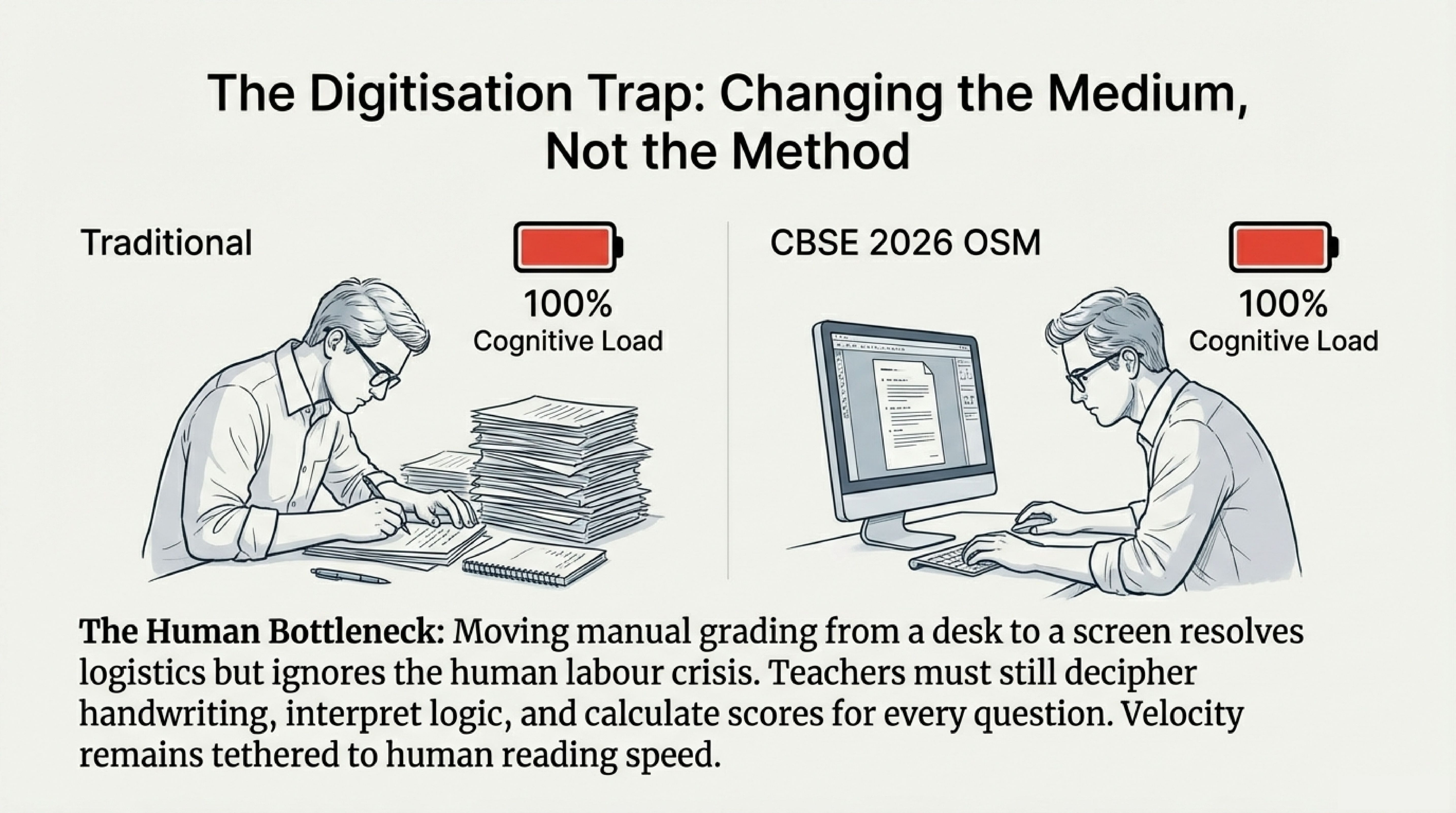
Their "Digitisation Trap" slide makes it visible. Left: traditional marking, desk and paper, 100% cognitive load. Right: CBSE 2026 OSM, screen and keyboard, still 100%. Shifting from desk to screen fixes logistics. It doesn't fix the human bottleneck. Someone still has to interpret logic, apply the rubric, and add up scores question by question. Speed still depends on how fast a person reads and decides. That's teacher burnout in plain view. Any automated assessment that only displays the script leaves that untouched.
How GradeLab Reads Instead of Just Showing
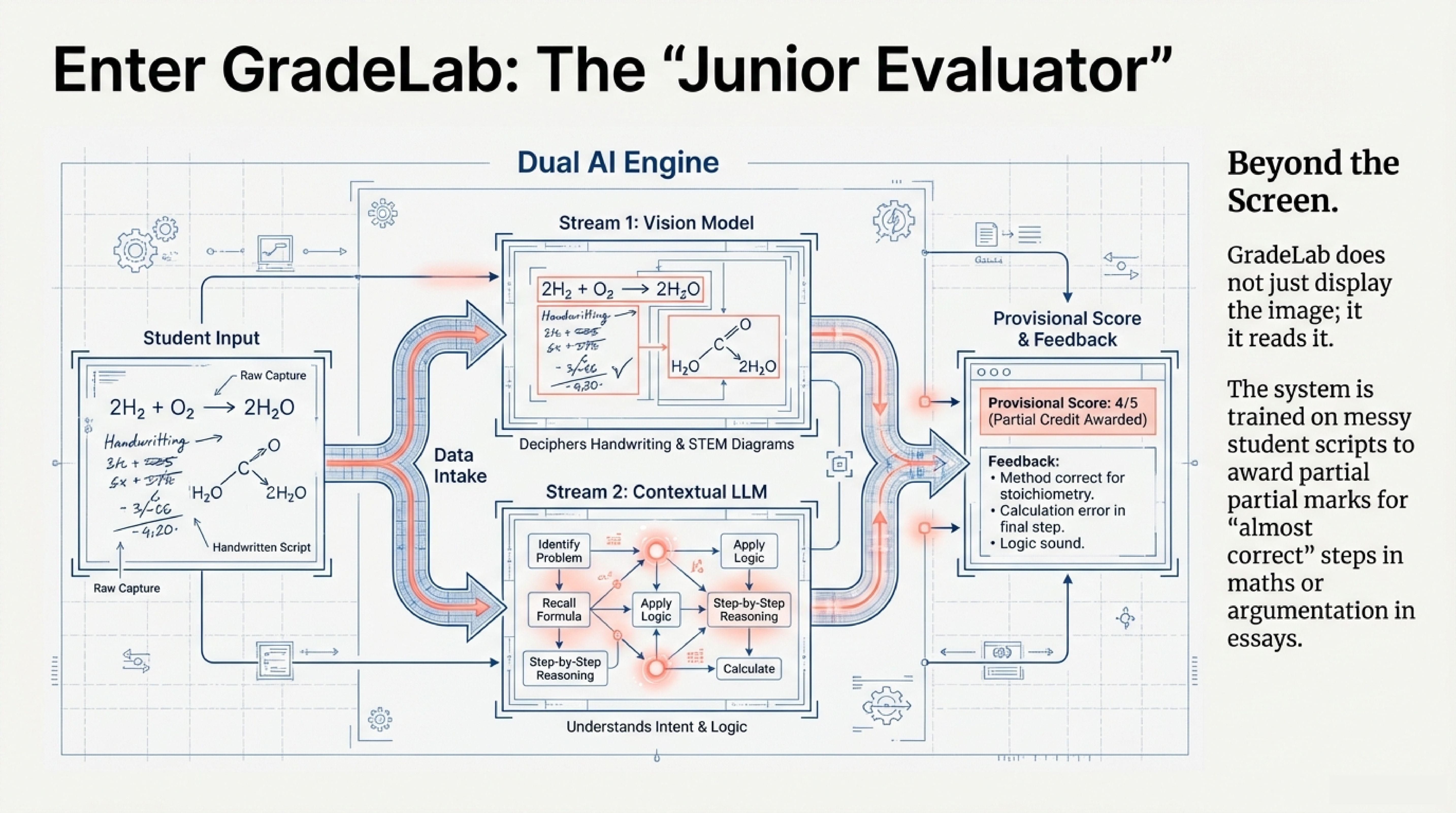
GradeLab's claim: they don't only display the image. They read it. Two engines. First, a vision model that handles structure and diagrams (including STEM). Second, a contextual LLM that tracks the logic: problem, formula, steps, calculation. The output is a provisional score plus feedback. Example: 4/5 with partial credit, method correct for stoichiometry, calculation error in the last step, logic sound. AI grading that follows the reasoning chain, not only the final answer. That's the "Junior Evaluator" in practice.
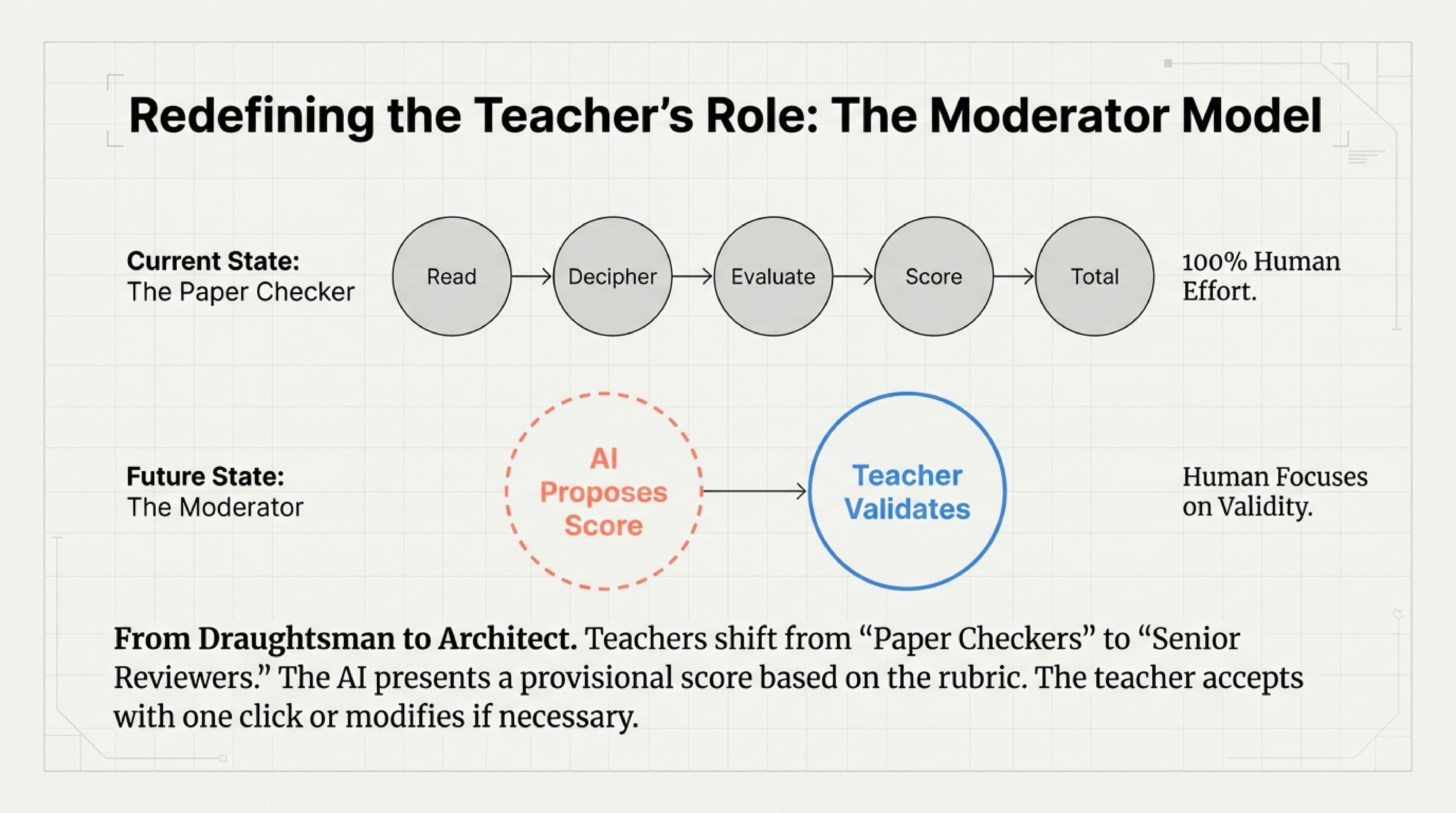
The role shift: today the teacher reads, deciphers, evaluates, scores, and totals. Full human effort. In the new setup, AI proposes the score. The teacher validates. They use the phrase "From Draughtsman to Architect." The teacher becomes senior reviewer. The AI offers a provisional score against the rubric; the teacher accepts with one click or adjusts. Human-in-the-loop. Consistency comes from the rubric and the engine. The human owns validity and edge cases.
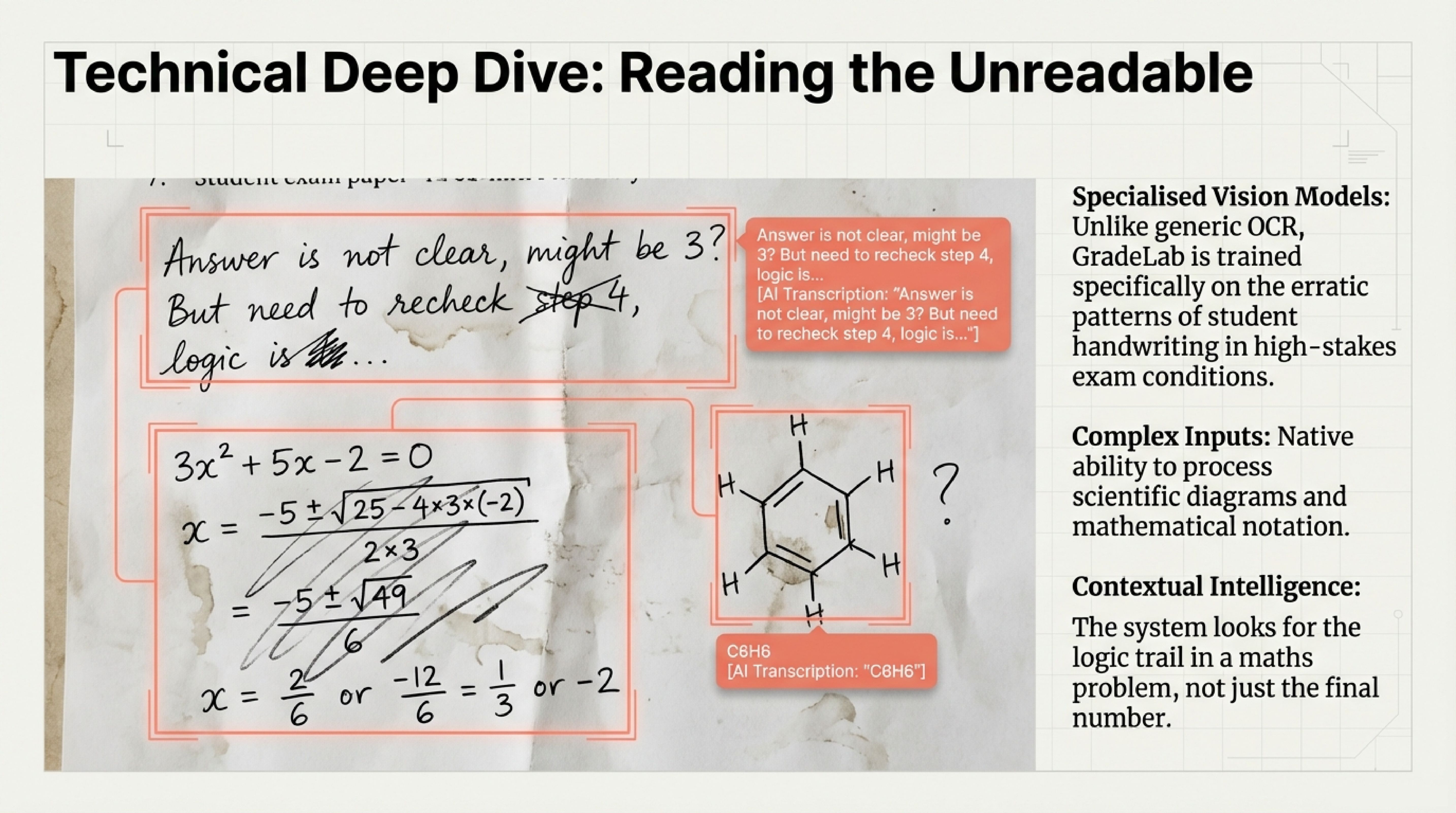
The "Reading the Unreadable" angle is the technical one. They're not running generic OCR. They handle messy, real-world student input: equations, notation, diagrams (e.g. chemical structures). The system is built to follow the logic trail in a maths problem, not just the final number. You end up with automated feedback at forensic grade, not low-quality scanning. For high-stakes exams that distinction matters.
Time and Cost: What Boards Actually Gain
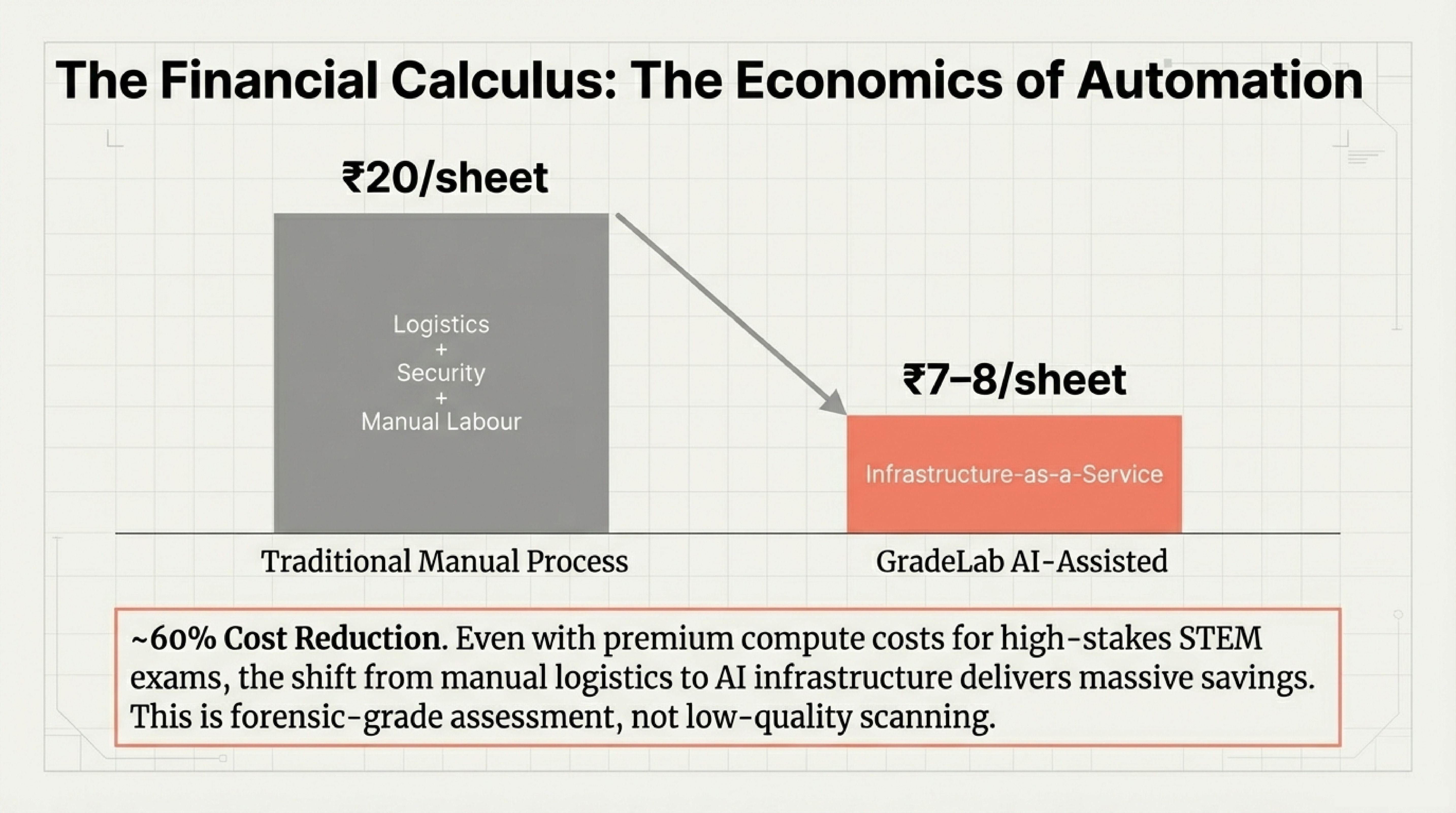
On cost they're direct. Traditional manual: ₹20 per sheet. Logistics, security, labour. GradeLab AI-assisted: ₹7-8 per sheet. Delivered as Infrastructure-as-a-Service. They quote around 60% cost reduction even with premium compute for high-stakes STEM. So the offer isn't "cheap scanning." It's forensic-grade assessment at a fraction of manual cost.
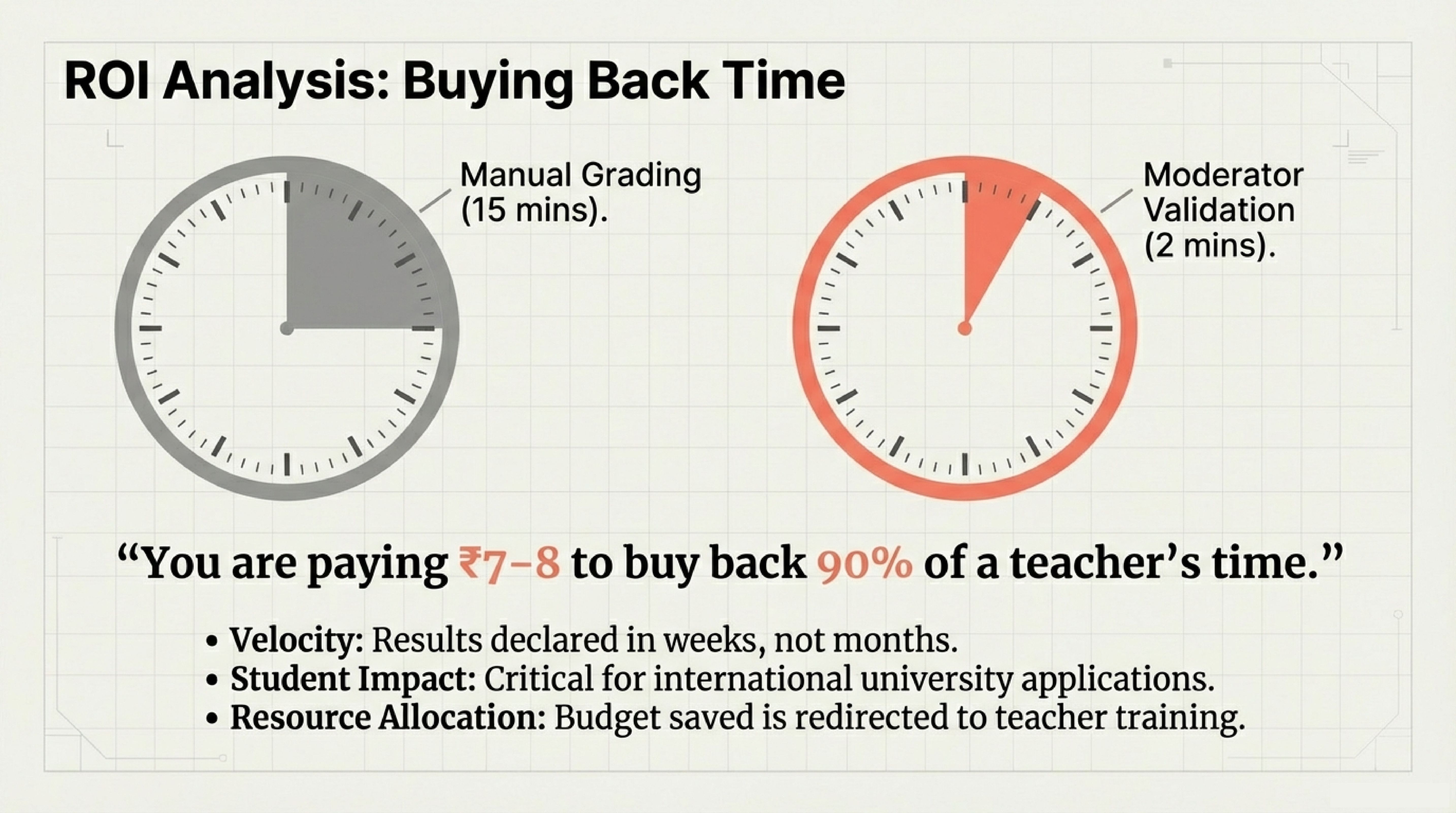
In time terms: manual grading in the ballpark of 15 minutes per script. With GradeLab, moderator validation around 2 minutes. Their framing: You pay ₹7-8 to buy back 90% of a teacher's time. They also highlight results in weeks instead of months (important for university applications) and redirecting saved budget into teacher training. So the gain is cost plus resource allocation and student impact.
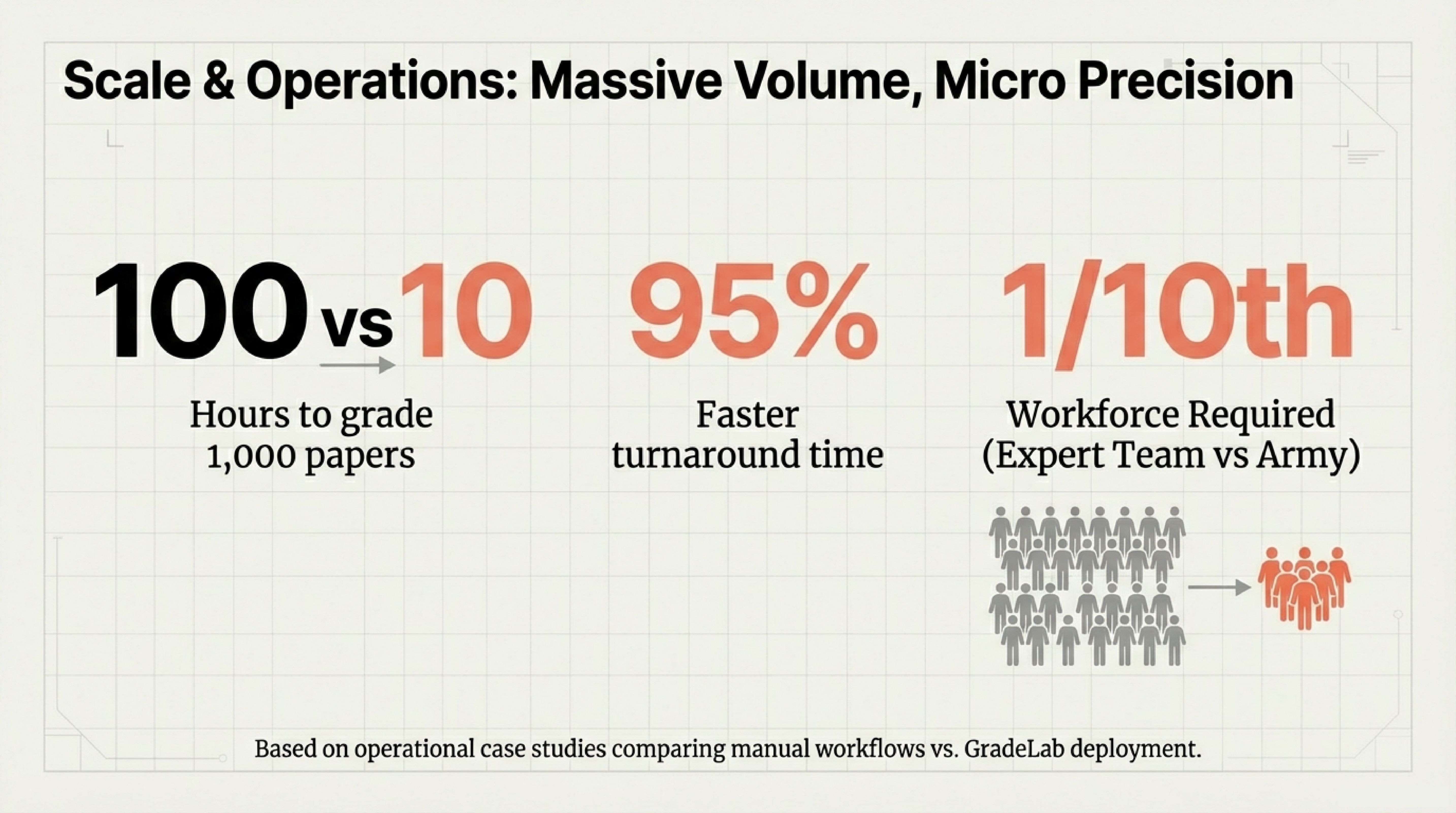
At scale: grading 1,000 papers. 100 hours manual vs 10 hours with GradeLab. 95% faster turnaround. They also show it as 1/10th of the workforce: an "army" of markers versus a small expert team. The footnote ties this to operational case studies. So these aren't back-of-the-envelope numbers; they're from live deployments.
Trust, Security, and the Hybrid Setup
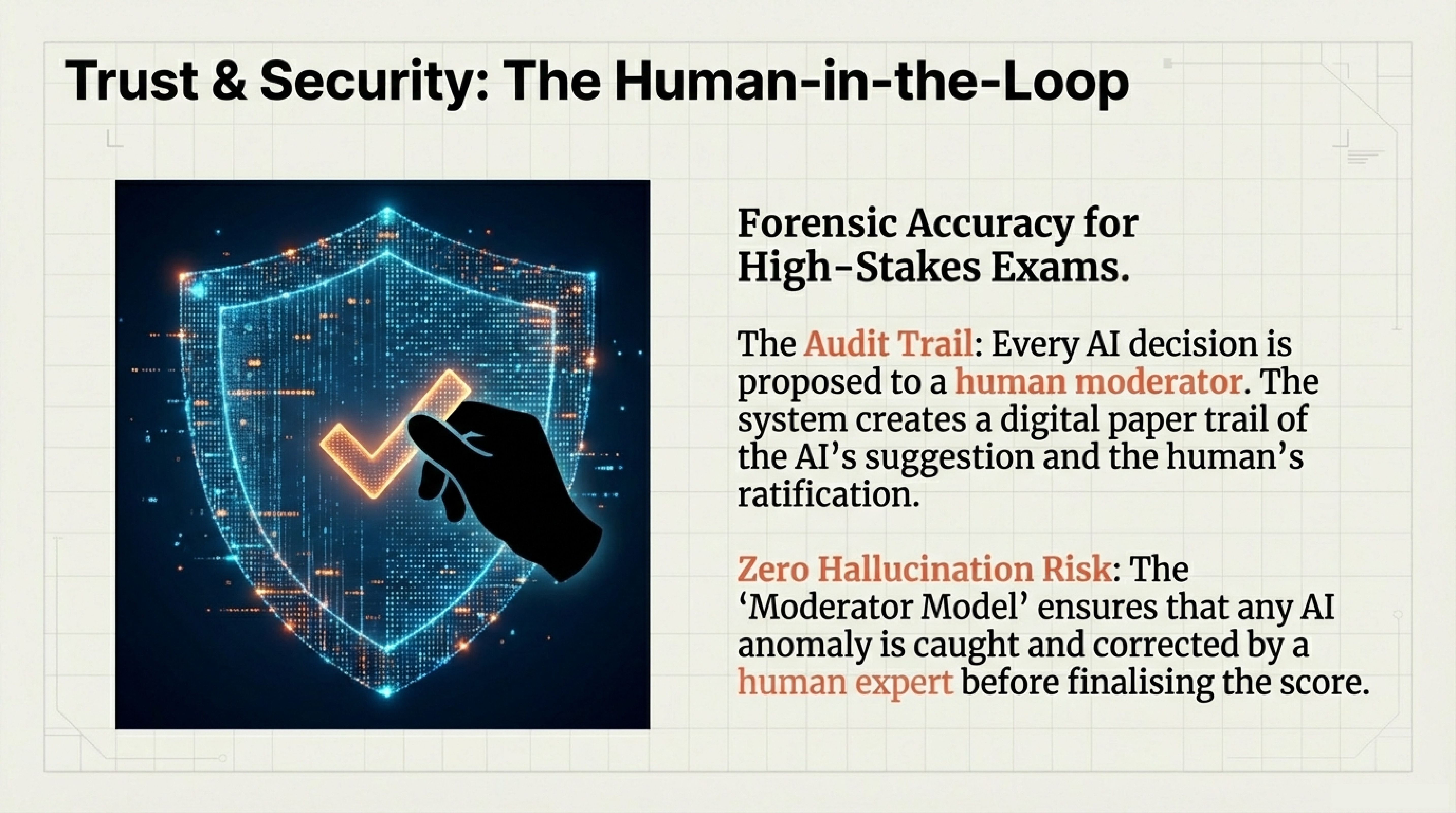
High-stakes assessment needs forensic accuracy. Their trust slide lays it out. Every AI decision is proposed to a human moderator. The system maintains a digital audit trail: what the AI suggested and how the human ratified it. The "Moderator Model" means any odd or incorrect AI output is caught and corrected by a human before the score is locked. So you keep academic integrity without taking on "AI hallucination" risk. For national boards that's baseline. GradeLab's enterprise offering includes Virtual Private Cloud (VPC) deployment so data remains inside the board's or government cloud. Data sovereignty and audit requirements for CBSE and similar boards are addressed.
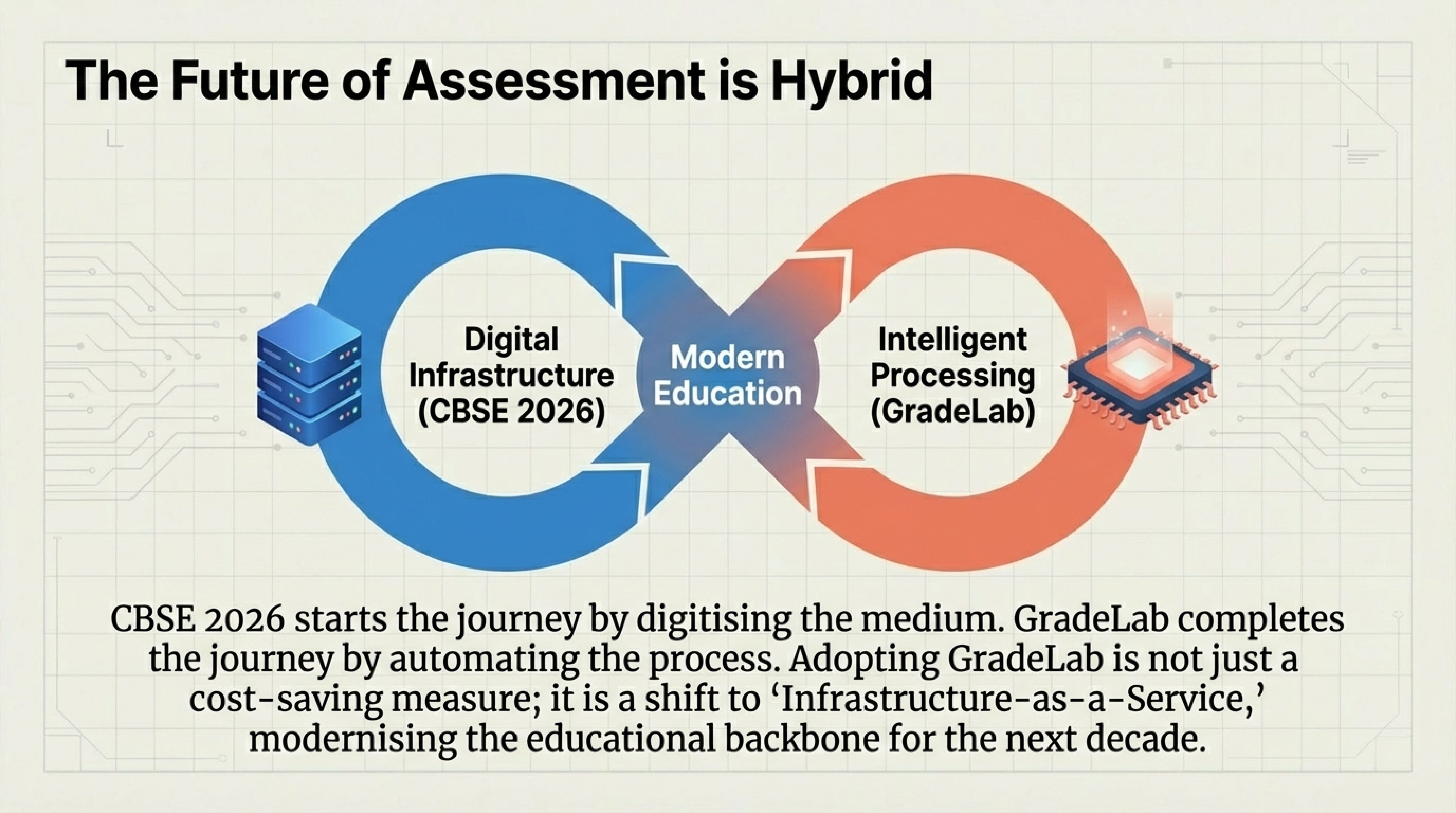
Their closing frame: The future of assessment is hybrid. One loop is digital infrastructure (CBSE 2026). The other is intelligent processing (GradeLab). They meet at "Modern Education." CBSE 2026 digitises the medium. GradeLab automates the process. Adopting GradeLab isn't only about cost saving. It's a move to Infrastructure-as-a-Service and modernising the assessment backbone for the next decade. That's digital transformation in schools in a single frame.
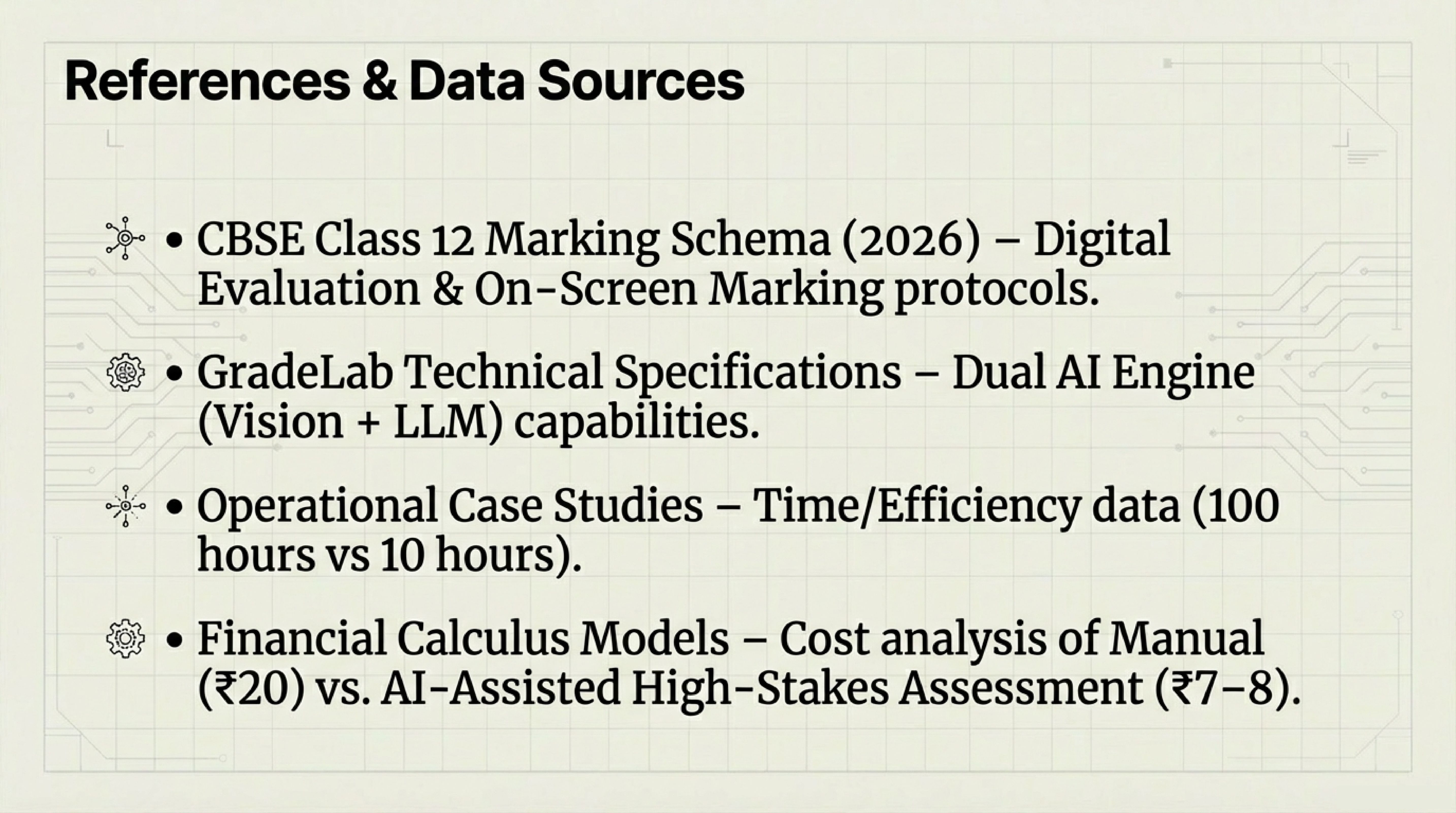
Their references ground it: CBSE Class 12 marking schema (2026), OSM protocols, GradeLab's dual AI (Vision + LLM), case studies (100 vs 10 hours), and financial models (manual ₹20 vs AI-assisted ₹7-8). The figures in this post align with those sources.
Wrap
OSM puts scripts on a screen. Intelligent automation gets the system to understand the script and propose scores so teachers validate instead of grind. That's the step from "digitise the paper" to "digitise the effort." GradeLab delivers it via a dual AI engine, human-in-the-loop, roughly 95% faster turnaround, roughly 60% cost reduction, and VPC-ready deployment for boards that need data sovereignty. If you're a principal, dean, or board lead planning for 2026, the real choice isn't digital or not. It's whether you stop at OSM or take the next step.
Ready to turn the burden of assessment into a strategic asset?


