How much we save universities
Universities save up to 80% on grading costs while improving consistency and speed across departments
Universities save up to 80% on grading costs while improving consistency and speed across departments
Streamlined assessment workflows that reduce administrative overhead and improve faculty productivity
80%
80% time saved
Track and analyze how universities benefit from automated grading and assessment solutions




Trusted by 1k+
Automated Extraction
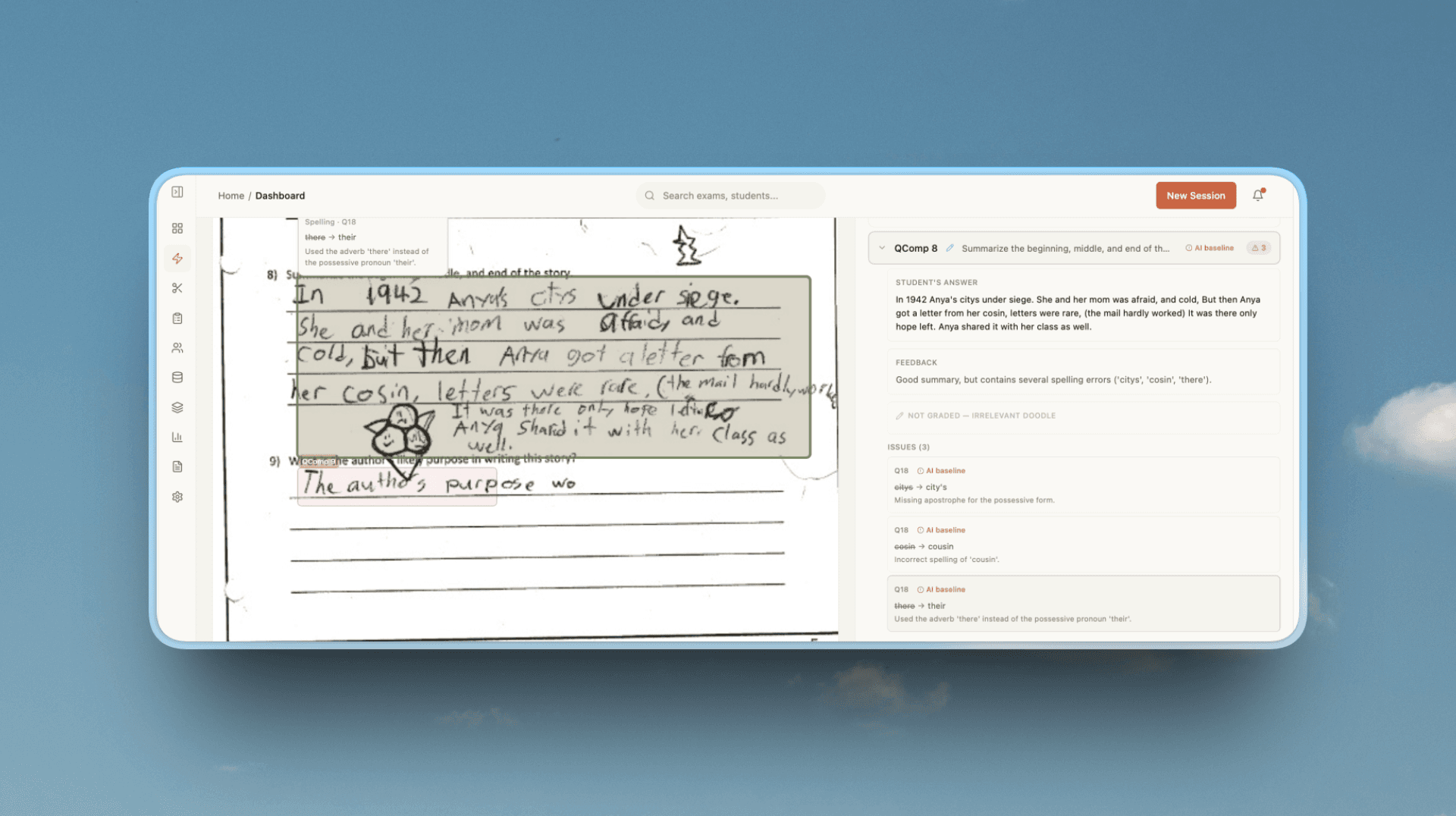
Instantly converts scanned exam papers into structured digital data. Our AI automatically identifies and maps student information, question numbers, and answer regions. No manual setup required.
30+ Languages
Arabic, Chinese, German & more
Compare & Validate
Complete control over results
Understands Every Answer
Intelligently processes diverse answer formats from handwritten essays to diagrams and mathematical equations. Adapts to any exam layout while maintaining accuracy across question types.
From handwritten essays to digital quizzes, GradeLab handles it all with the same precision and speed.

.png&w=640&q=75)





Everything you need to automate grading with AI accuracy and teacher control.
Grade 200 handwritten exams in under 30 minutes. What takes 4 hours manually now takes 20 minutes with AI.
99%+ accuracy in reading handwritten answers across all subjects. Trained on millions of real student exams.
On-premise deployment keeps your exam data secure within your institution. Zero cloud dependency.
Grade essays, math problems, diagrams, MCQs, and mixed formats. Supports 30+ languages including Arabic and Chinese.
Review and adjust any AI grade with one click. You stay in control while AI handles the heavy lifting.
See class performance, question difficulty, and student progress the moment grading completes. Spot trends instantly.
You teach English, or history, or social sciences, and the essays pile up. You want to give every student meaningful feedback. You want to read their argument carefully, check their evidence, evaluate their structure, and write a comment that actually helps them improve. That is the job. That is the part of teaching you care about.
But after 40 essays your eyes are tired and your comments get shorter. The first ten students get a paragraph of thoughtful feedback. The next ten get two sentences. The last ten get a mark and a few words, if they are lucky. It is not because you do not care. It is because you are human, and grading 40 essays in one sitting is a kind of endurance test that nobody designed for quality.
And you know the students at the bottom of the stack are getting a different version of you than the students at the top. Not a worse version, just a different one. More tired. Less generous with the benefit of the doubt. Quicker to find the flaw and slower to see what the student did well. You know it is happening and you cannot stop it, because the pile does not get smaller while you rest.
Then there is the feedback itself. You write the same comment five different ways across five different essays because you are trying to say the same thing but the words keep changing. A student asks why they got a 72 instead of a 78 and you have to go back, find the essay, re-read it, and reconstruct your reasoning. You know you had a reason. You just cannot remember what it was at midnight on a Sunday.
An AI grader for essays reads each submission, evaluates argument, evidence, structure, and writing quality against your rubric, and writes specific feedback for every student. You review, edit, and approve. The AI does not replace your judgement. It gives you a head start so every student gets the attention they deserve, not just the first ten.
An AI grader for essays is software that reads each student essay, evaluates it against your rubric, and writes specific feedback for every student. You upload your rubric, add custom instructions in plain English, and the AI grades every essay against your exact criteria.
GradeLab does not just match keywords or count sentences. It reads the full essay, evaluates argument structure, evidence use, reasoning quality, and writing mechanics. It explains why each mark was awarded or deducted, so you can see the reasoning before you approve. You can add custom instructions like “give credit for original argument even if I disagree with the conclusion” or “penalise only if the argument lacks evidence.”
You still have full control. You review every score and comment, override anything you disagree with, edit feedback so it sounds like you wrote it, and release grades only when you are satisfied. The AI gives you a consistent starting point. You make the final call. Every student gets meaningful feedback, not just the ones at the top of the stack.
GradeLab grades essays across English, history, social sciences, and more. Upload your rubric, add custom instructions, and the AI evaluates each essay against your criteria consistently.
Watch how AI grading and online assessment work end-to-end, from upload to results.
GradeLab does not guess a score. It reads the full essay, evaluates each rubric criterion, and writes specific feedback for every student. It works the way you intended your grading to work.
The AI does not just scan for keywords. It reads the entire essay, understands the argument, evaluates the evidence, and checks the structure against your rubric.
Upload the rubric you already use. The AI applies each criterion to every essay. Paper 1 and paper 100 get the same standard, with no fatigue or drift.
Tell the AI to give credit for original argument even if you disagree with the conclusion. Tell it not to penalise for spelling when the meaning is clear. The AI follows your instructions on every essay.
Every student gets feedback that explains where they lost marks and what to improve. You can edit the feedback before it goes out so it sounds like you wrote it, because you approved it.
Instead of reading 40 essays front to back, you review only the ones the AI flags. You see the essay, the rubric, the AI reasoning, and the suggested score before you make the final call.
The AI does not get tired. It applies the same standard on essay 1 and essay 40. The students at the bottom of the stack get the same quality of grading as the students at the top.
GradeLab suggests. You decide. Override any score, rewrite any feedback comment, add your own notes. Nothing reaches a student until you have approved it.
English literature, history, political science, sociology, philosophy. GradeLab handles argumentative essays, research papers, short responses, and comparative analyses with subject-appropriate rubrics.
Upload an entire class of essays. Track progress in real time. GradeLab processes the batch and returns suggested scores with feedback for your review in minutes.
Explore our AI essay grader, try grading with an AI essay grader with rubric support, or learn about essay grading AI for every subject.
See how GradeLab stacks up against manual essay grading and other AI essay tools.
AI essay grading with teacher override on every mark
Pricing
Free to start
Features
Best for
Teachers who want AI essay grading with full control
Limitations
None for most use cases
Pricing
Free but costs your time
Features
Best for
Small classes with few essays
How it compares to GradeLab
Takes 6-8 hours per class vs 15 minutes with GradeLab
Limitations
Slow, inconsistent feedback, no audit trail, fatigue by paper 40
Pricing
$10-50/month
Features
Best for
Simple short essays
How it compares to GradeLab
Generic AI without custom instructions or teacher override
Limitations
No custom instructions, no teacher override, no audit trail
Governments, institutions, and AI ecosystems worldwide. Delivering secure, scalable, and accurate handwritten assessment solutions.
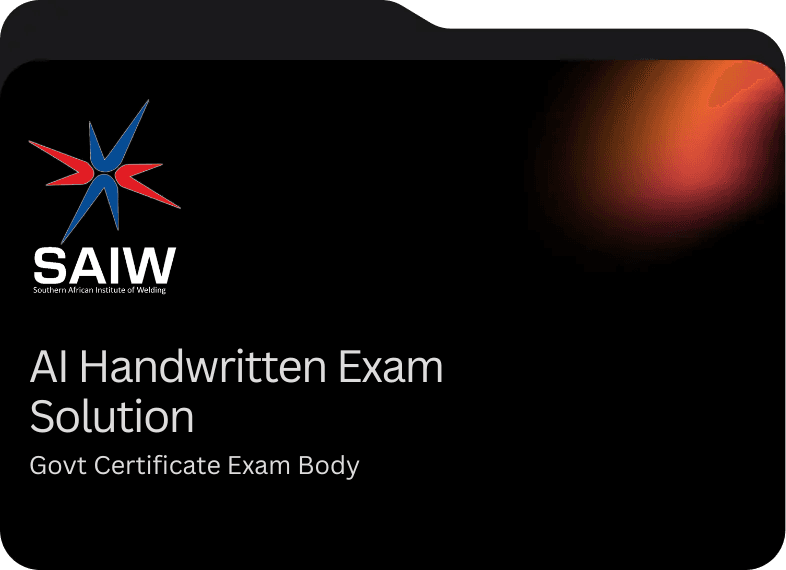
Official assessment workflows for certified exam bodies and large-scale handwritten examinations.
.30c80c0c.png&w=1920&q=75&dpl=dpl_7wHhG9EEN57BJTKfg2KL4c4ARpTn)
Enterprise-grade AI grading deployed for national-level academic and workforce assessments.
Fine-tuned OCR and grading models built specifically for real-world exam handwriting.
From upload to feedback in minutes
Bulk upload or paste text. Upload an entire class of essays at once. The AI reads each submission and prepares it for grading.
Define criteria for content, structure, evidence, and style. Add custom instructions like "give credit for original argument even if I disagree with the conclusion." The AI follows your rules on every essay.
See every score and per-criterion comment. The AI flags essays that need your attention. Override or edit anything before releasing to students.
Students get specific, actionable feedback so they know exactly what to improve. Sync grades to your LMS or export in one click.
An AI grader for essays reads each submission, evaluates argument, evidence, structure, and writing quality against your rubric, and writes specific feedback for every student. You review, edit, and approve. The AI does not replace your judgement. It gives you a head start so every student gets the attention they deserve.
Yes. GradeLab grades essays across every subject. Whether you teach English literature, history, political science, or sociology, you upload your rubric, add custom instructions, and the AI evaluates each essay against your criteria. It handles argumentative essays, research papers, short responses, and comparative analyses.
The AI reads the full essay, not just keywords. It evaluates argument structure, evidence use, reasoning quality, and writing mechanics against your rubric. It explains why each mark was awarded or deducted, so you can see the reasoning before you approve. You can override any score at any time.
Yes. Every student gets specific feedback on where they lost marks and what to study next, not just a number. You can edit the feedback before it goes out, so it sounds like you wrote it, because you approved it.
A class of 40 essays comes back with suggested scores and feedback in under 10 minutes. You then review the flagged essays, check anything you want to double-check, and approve. Most teachers finish the full review in another 15 to 20 minutes.
Yes. You write your rules in plain English and the AI follows them on every essay. For example, you can tell the AI to give credit for original argument even if you disagree with the conclusion, or to penalise only if the argument lacks evidence. The AI applies your instructions consistently on every paper.

Thomas Braun
Lecturer, Pure Mathematics, Germany
My students write formal mathematical proofs. On a convergence proof question, GradeLab correctly identified whether the quantifier structure was right, whether the chosen bound worked, and where the logical chain broke. It did not just check the final line. That is the part that matters.

Dr. Isabelle Fontaine
Associate Professor, Theoretical Physics, France
GradeLab evaluated a wavefunction normalisation problem across 140 papers and correctly flagged eleven cases where students had a correct final integral but had used the wrong boundary condition. That is precise, subject-aware marking.

Prof. James Fletcher
Mechanical Engineering, Thermodynamics, USA
GradeLab evaluated a question on entropy generation in a throttling process and correctly identified which students had omitted the system definition, which had applied the steady-flow energy equation incorrectly, and which had confused entropy change with entropy generation. That distinction matters in this subject and it caught it reliably.
Thomas Braun
Lecturer, Pure Mathematics, Germany
My students write formal mathematical proofs. On a convergence proof question, GradeLab correctly identified whether the quantifier structure was right, whether the chosen bound worked, and where the logical chain broke. It did not just check the final line. That is the part that matters.
Dr. Isabelle Fontaine
Associate Professor, Theoretical Physics, France
GradeLab evaluated a wavefunction normalisation problem across 140 papers and correctly flagged eleven cases where students had a correct final integral but had used the wrong boundary condition. That is precise, subject-aware marking.
Prof. James Fletcher
Mechanical Engineering, Thermodynamics, USA
GradeLab evaluated a question on entropy generation in a throttling process and correctly identified which students had omitted the system definition, which had applied the steady-flow energy equation incorrectly, and which had confused entropy change with entropy generation. That distinction matters in this subject and it caught it reliably.

Sophie Laurent
Science Teacher, Lycée Henri IV, Paris
Before GradeLab, I spent every Sunday grading papers instead of being with my family. Now I upload the batch on Friday evening and by Saturday morning, every student has already seen their feedback. That part still surprises me.

Maria Santos
Teacher, Escola Internacional de Lisboa
I teach four classes with 35 students each. I genuinely could not keep up with grading. GradeLab didn't just save me time - it gave me back the ability to actually know where each student was struggling.

Sarah Mitchell
Head of Academics, Wellington Grammar School
We trialled several edtech platforms before GradeLab. What stood out was that it wasn't just grading software - the student feedback loop was instant, and the quality reports for governors were exactly what we needed.
Sophie Laurent
Science Teacher, Lycée Henri IV, Paris
Before GradeLab, I spent every Sunday grading papers instead of being with my family. Now I upload the batch on Friday evening and by Saturday morning, every student has already seen their feedback. That part still surprises me.
Maria Santos
Teacher, Escola Internacional de Lisboa
I teach four classes with 35 students each. I genuinely could not keep up with grading. GradeLab didn't just save me time - it gave me back the ability to actually know where each student was struggling.
Sarah Mitchell
Head of Academics, Wellington Grammar School
We trialled several edtech platforms before GradeLab. What stood out was that it wasn't just grading software - the student feedback loop was instant, and the quality reports for governors were exactly what we needed.