
Mark faster with
AI that marks like you
Add your custom instructions. Upload handwritten or digital assessments. GradeLab applies your marking scheme, suggests marks, and writes feedback. You review and approve every result.



Trusted by 1k+
Educational professors
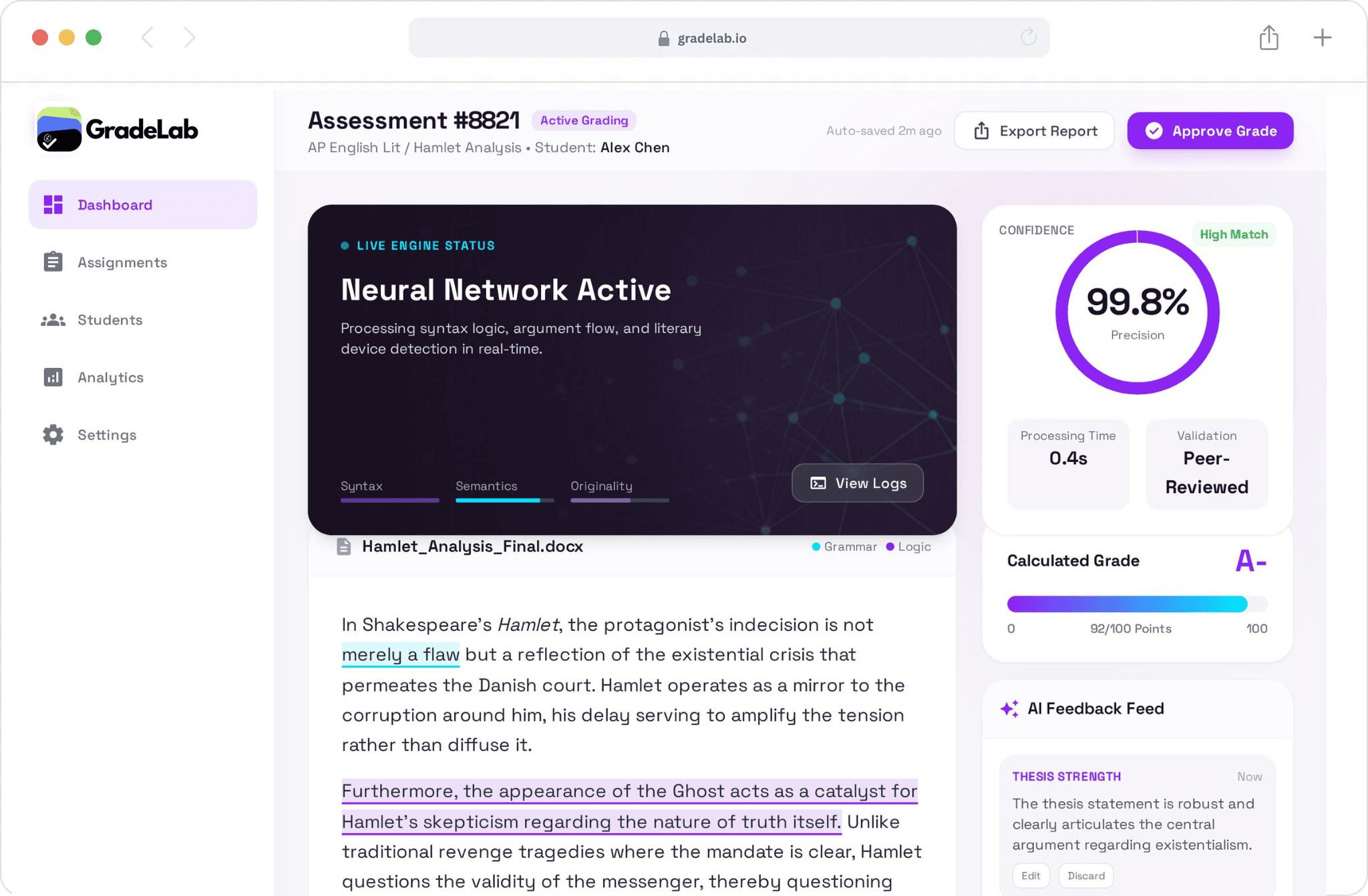
Smart Data Mapping
Automated Extraction
Instantly converts scanned exam papers into structured digital data. Our AI automatically identifies and maps student information, question numbers, and answer regions. No manual setup required.
Multilingual OCR
30+ Languages
Arabic, Chinese, German & more
AI Moderation
Compare & Validate
Complete control over results
Smart Automation
Understands Every Answer
Intelligently processes diverse answer formats from handwritten essays to diagrams and mathematical equations. Adapts to any exam layout while maintaining accuracy across question types.


One Platform, Every Format
From handwritten essays to digital quizzes, GradeLab handles it all with the same precision and speed.
Trusted by leading institutions

.png&w=640&q=75)





You know the feeling.
It is 9 PM on a Sunday. You have been marking since the afternoon. Paper 31 is sitting in front of you, and the handwriting on question 5 is barely legible. You squint at it, try to read what the student wrote, cross-reference it against the mark scheme, and realise you are spending more time deciphering than evaluating. The student's actual understanding is hidden behind messy handwriting and your own tiredness.
Paper 32 is worse. You catch yourself marking it more leniently than paper 1, because you are tired and the rubric that felt crystal clear at 2 PM now feels ambiguous. You know this happens to every marker. You also know that when a parent or student challenges the result, you will not be able to explain exactly why three marks were deducted on a specific question six weeks ago.
Then there is the feedback problem. You want to write something useful for every student, something that tells them what they got wrong and how to fix it. But 140 papers times three sentences each is 420 sentences, and you have already been at this for five hours. So most students get a mark and nothing else.
This is the problem GradeLab was built to solve. Not to replace your judgement, but to handle the parts that drain your time so you can focus on the parts that matter: reviewing the uncertain answers, giving meaningful feedback, and making the final call on every result.
What Is an AI Marking Tool?
An AI marking tool reads your students' submissions, applies the marking scheme or rubric you already use, suggests a mark for each question, and writes feedback that explains where marks were lost. You review every suggestion, override anything you disagree with, and approve the results before they reach students.
GradeLab lets you add your own custom instructions so the AI marks the way you would. Tell it to be strict on units in physics. Tell it to award method marks even when the final answer is wrong. Tell it to look for a specific formula before awarding full credit. The AI follows your instructions on every paper, consistently, whether it is paper 1 at 2 PM or paper 200 at midnight.
The word "marking" is what teachers in the UK, Australia, India, Singapore, and across the Commonwealth actually call this process. In the US, it is usually called "grading." GradeLab supports both, because the workflow is the same: read the work, apply the standard, give the feedback, and keep the teacher in control.
How AI Marking Is Different from Marking by Hand
| What changes | Marking by hand tonight | Marking with GradeLab |
|---|---|---|
| Time for one class | 4 to 8 hours of your evening | Under 10 minutes for suggestions, then your review |
| Consistency | Paper 200 gets a different version of you than paper 1 | Same rubric, same instructions, every paper |
| Feedback | A mark per question if you have time | Specific feedback for every student on every question |
| Uncertain answers | You read every answer to find the tricky ones | Low-confidence answers flagged and sent to your queue |
| If a mark is challenged | You try to remember why you deducted those marks | Full reasoning is visible and exportable |
| Your role | You do everything by hand | You review, you decide, you approve. The AI does the heavy lifting. |
One Marking Platform. Every Assessment Type.
GradeLab handles handwritten exams, digital submissions, essays, mathematics, and mixed-format booklets, all with your marking scheme and custom instructions applied consistently.
See GradeLab in action
Watch how AI grading and online assessment work end-to-end, from upload to results.
Marking Tools for Teachers That Handle Real Work
GradeLab is not a generic AI that guesses a score. It is a marking tool that reads handwriting, follows your mark scheme, and explains every mark decision. It works on the assessments your institution actually runs.
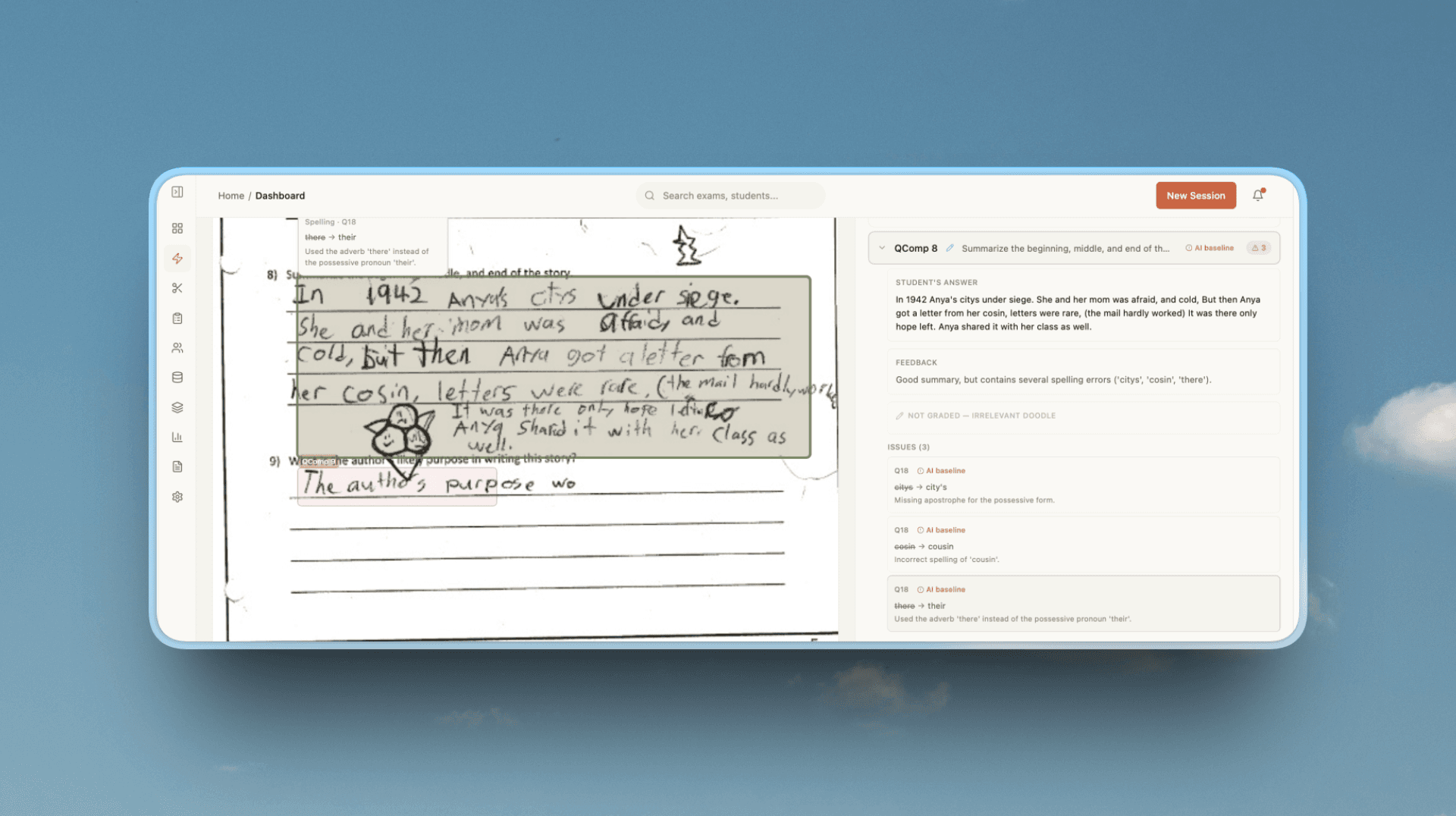
Reads Handwritten Answer Sheets
Upload what you already have: scanned papers, phone photos, or a full batch from the scanner. GradeLab reads the handwriting, figures out which answer goes with which question, and gets every response ready for marking.
Follows Your Mark Scheme
Upload your rubric or answer key. Add custom instructions like "award method marks even if the final answer is wrong" or "deduct one mark for missing units." GradeLab applies your rules on every paper, the same way, every time.
Step Marks and Partial Credit
A student who set up the problem correctly but made an arithmetic error deserves credit for the method. GradeLab evaluates each step, awards partial credit, and only deducts where a specific step actually fails.
Flags the Answers That Need You
Instead of reading 140 papers front to back, you review only the answers the AI is unsure about. Low-confidence responses are flagged and sent to your review queue. You see the original answer, the applied rubric, and the AI reasoning before you make the final call.
Marks a Full Batch at Once
Upload an entire exam sitting. 30 papers, 100 papers, 500 papers. Track progress in real time. GradeLab processes the batch and returns suggested marks for your review, so you can release results the same day.
Feedback for Every Student
Every student gets specific feedback on where they lost marks and what to study next, not just a number. You can edit the feedback before it goes out, so it sounds like you wrote it, because you approved it.
You Override Anything
GradeLab suggests. You decide. Override any mark, rewrite any feedback comment, add your own notes. Nothing reaches a student until you have approved it. The AI is your assistant, not your replacement.
Audit Trail When It Matters
When a student challenges a mark or the exam office asks for rationale, every decision is there: the original answer, the rubric applied, the AI reasoning, your override, and the final mark. Export it as a report.
Marks in Multiple Languages
English, Hindi, and verified regional languages. If your students write answers in a mix of languages on the same paper, GradeLab handles that too.
Mark It Like You Would
Every teacher has their own way of marking. Maybe you are strict about showing working in maths. Maybe you give credit for a good attempt even if the answer is wrong. Maybe you deduct marks for missing units, or maybe you let it slide if the physics is correct.
GradeLab lets you add custom instructions so the AI marks the way you would. You write your rules in plain English, and the AI applies them to every paper in the batch. Here is what that looks like:
"Award full marks for method even if the final numerical answer is wrong. Deduct one mark only if the student did not show any working."
"For essay questions, give credit for original argument structure. Do not penalise for spelling if the meaning is clear. Penalise only if the argument lacks evidence."
"In physics, always check units. Deduct half a mark if the answer is numerically correct but missing units."
"For this exam, accept both method A and method B for question 7. They are alternative valid approaches."
The AI follows your instructions on paper 1 and paper 200 the same way. No fatigue, no inconsistency, no "I forgot what I decided on the first one." You still review and override anything you want. But the starting point is your standard, not a generic one.
What Kind of Papers Can You Mark?
GradeLab is not a one-subject tool. It marks the assessments your institution actually gives, in the formats your students actually use.
Essays and Long-Form
Evaluates argument, evidence, reasoning, and writing quality against your rubric criteria.
Maths and Science
Step-wise working, partial credit, formula recognition, and diagram awareness.
Short Answer and MCQ
Objective scoring with recognition of alternative valid answers and negative marking.
Handwritten Exams
OCR reads the handwriting, maps answers to questions, and suggests marks per question.
Digital Submissions
Online exam submissions marked on completion with the same review workflow.
Lab Reports and Code
Structured reports, pseudocode, and programming assignments with logic evaluation.
Mixed-Format Booklets
Multi-page answer booklets with a mix of handwritten and typed answers in one paper.
Multilingual Papers
English, Hindi, and verified regional languages. Handles mixed-language answer sheets.
"Marking" or "Grading"? Same Job, Different Word.
If you teach in London or Delhi, Melbourne or Mumbai, you probably say "marking." If you teach in New York or Toronto, you probably say "grading." The workflow is identical: read the student's work, apply the standard, suggest a mark, give feedback, and keep the teacher in control.
GradeLab is built for both. Whether your institution calls it an AI marking tool or an AI grading tool, the platform does the same thing: it reads the work, applies your rubric, suggests marks, and waits for your approval.
Where teachers say "marking"
- United Kingdom and Ireland
- Australia and New Zealand
- India
- Singapore and Malaysia
- South Africa
- Other Commonwealth countries
Where teachers say "grading"
- United States
- Canada
- Philippines
- International SaaS and EdTech terminology
Compare AI grading tools for teachers, explore our AI exam marking tool, or try essay marking with rubric-based feedback.
Powering Assessment for
Governments, institutions, and AI ecosystems worldwide. Delivering secure, scalable, and accurate handwritten assessment solutions.
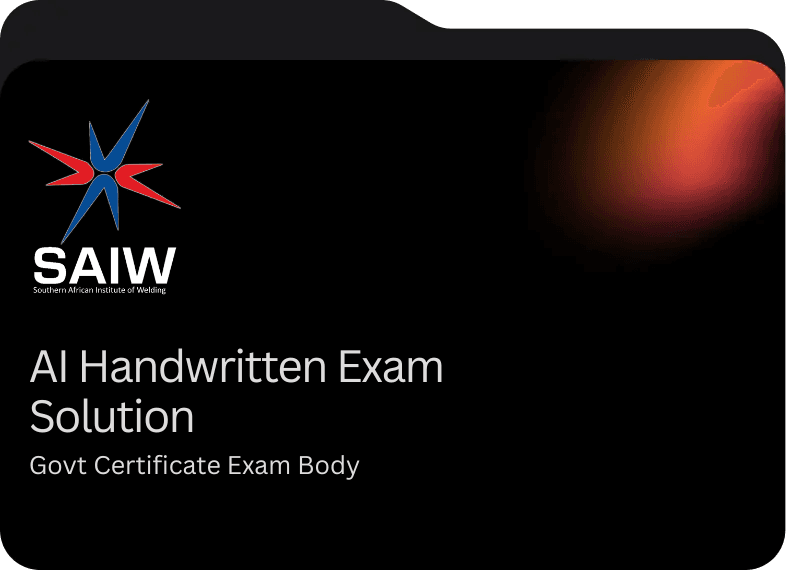
Government-Certified AI Handwritten Evaluation
Official assessment workflows for certified exam bodies and large-scale handwritten examinations.
.30c80c0c.png&w=1920&q=75&dpl=dpl_783MS92wYpeV86k9voFD6ofUd7io)

Enterprise Public Sector AI Grading Systems
Enterprise-grade AI grading deployed for national-level academic and workforce assessments.
Custom AI Grading & OCR Infrastructure
Fine-tuned OCR and grading models built specifically for real-world exam handwriting.
How AI Marking Works
From Upload to Final Mark in Minutes
1
Upload Your Papers
Upload scanned handwritten papers or digital submissions. You can also take photos with your phone. GradeLab organises pages, identifies questions, and prepares every response for marking.
2
Add Your Instructions and Mark Scheme
Upload your rubric or mark scheme. Add custom instructions in plain English: how strict to be, what to accept, what to penalise. GradeLab follows your rules on every paper.
3
Review the Suggested Marks
GradeLab returns suggested marks per question with visible reasoning. Low-confidence answers are flagged and sent to your review queue. You focus on the tricky ones, not the easy ones.
4
Approve and Release Feedback
Override any mark, edit feedback, add your own comments, and approve. Students receive question-level feedback that explains where they lost marks and what to study next.
AI Marking Tool FAQ
What is an AI marking tool?
An AI marking tool reads your students' submissions, applies the marking scheme or rubric you already use, suggests a mark for each question, and writes feedback that explains where marks were lost. You review every suggestion, override anything you disagree with, and approve the results before they reach students. GradeLab does this for both handwritten and digital assessments, so you do not need two different tools.
How does AI marking differ from AI grading?
They are the same workflow with a different name. Teachers in the UK, Australia, India, Singapore, and across the Commonwealth say "marking." Teachers in the US and Canada usually say "grading." GradeLab supports both terms because the job is the same: read the work, apply the standard, give the feedback, and keep the teacher in control.
Can GradeLab mark handwritten exam papers?
Yes. Upload scanned papers or phone photos of handwritten answer sheets. GradeLab reads the handwriting using OCR, maps each answer to the correct question, applies your marking scheme, and suggests marks with visible reasoning. You review and approve every suggested mark before results go out. If the AI is unsure about a specific answer, it flags it for your attention instead of guessing.
Can I add my own custom marking instructions?
Yes. This is one of the core features teachers ask for. You write your rules in plain English and GradeLab follows them on every paper. For example: "award method marks even if the final answer is wrong" or "deduct one mark for missing units in physics." The AI applies your instructions consistently, whether it is paper 1 at 2 PM or paper 200 at midnight. You still review and override anything, but the starting point is your standard, not a generic one.
Can I override a suggested mark?
Yes, and you should. GradeLab is your assistant, not your replacement. Override any mark, rewrite any feedback comment, add your own notes, and finalize results only after you are satisfied. Nothing reaches a student without your approval. The AI does the heavy lifting so you can focus on the answers that actually need your judgement.
How long does it take to mark a class of papers?
A class of 30 papers comes back with suggested marks in under 5 minutes. You then review the flagged answers, check anything you want to double-check, and approve. Most teachers finish the full review in another 10 to 15 minutes. So instead of spending your entire evening marking, you are done before the kettle boils for your next cup of tea.
Is AI marking accurate for essays and long-form answers?
Yes. GradeLab does not just match keywords or count sentences. It reads the full response, evaluates argument structure, evidence use, reasoning quality, and writing mechanics against your rubric. It explains why each mark was awarded or deducted, so you can see the reasoning before you approve. If you teach literature or history and you want original argument rewarded even when you disagree with the conclusion, you can add that as a custom instruction.
What subjects does AI marking support?
GradeLab marks essays, short answers, mathematics with step-wise working, science problems, lab reports, code, diagrams, and mixed-format exams. It handles multilingual submissions including English, Hindi, and other verified languages.
How does AI marking handle marking consistency across multiple markers?
If you have ever wondered whether you marked paper 1 the same way you marked paper 100, you are not alone. Fatigue changes how we mark. GradeLab applies the same rubric and the same custom instructions on every paper, so the consistency problem goes away. When multiple educators mark the same assessment, GradeLab surfaces discrepancies for moderation so your department can standardise.
Can AI marking be used for standardised and board exams?
Yes. GradeLab supports the workflows your exam office needs: audit trails, marking rationale export, moderation, re-evaluation, and marks normalisation. When a student challenges a result, every decision is visible: the original answer, the applied rubric, the AI reasoning, your override, and the final mark. You can export it as a report for the appeals committee.
Trusted by educators across every discipline

Dr. Isabelle Fontaine
Associate Professor, Theoretical Physics, France
GradeLab evaluated a wavefunction normalisation problem across 140 papers and correctly flagged eleven cases where students had a correct final integral but had used the wrong boundary condition. That is precise, subject-aware marking.

Prof. James Fletcher
Mechanical Engineering, Thermodynamics, USA
GradeLab evaluated a question on entropy generation in a throttling process and correctly identified which students had omitted the system definition, which had applied the steady-flow energy equation incorrectly, and which had confused entropy change with entropy generation. That distinction matters in this subject and it caught it reliably.

Thomas Braun
Lecturer, Pure Mathematics, Germany
My students write formal mathematical proofs. On a convergence proof question, GradeLab correctly identified whether the quantifier structure was right, whether the chosen bound worked, and where the logical chain broke. It did not just check the final line. That is the part that matters.
Dr. Isabelle Fontaine
Associate Professor, Theoretical Physics, France
GradeLab evaluated a wavefunction normalisation problem across 140 papers and correctly flagged eleven cases where students had a correct final integral but had used the wrong boundary condition. That is precise, subject-aware marking.
Prof. James Fletcher
Mechanical Engineering, Thermodynamics, USA
GradeLab evaluated a question on entropy generation in a throttling process and correctly identified which students had omitted the system definition, which had applied the steady-flow energy equation incorrectly, and which had confused entropy change with entropy generation. That distinction matters in this subject and it caught it reliably.
Thomas Braun
Lecturer, Pure Mathematics, Germany
My students write formal mathematical proofs. On a convergence proof question, GradeLab correctly identified whether the quantifier structure was right, whether the chosen bound worked, and where the logical chain broke. It did not just check the final line. That is the part that matters.

Sophie Laurent
Science Teacher, Lycée Henri IV, Paris
Before GradeLab, I spent every Sunday grading papers instead of being with my family. Now I upload the batch on Friday evening and by Saturday morning, every student has already seen their feedback. That part still surprises me.

Maria Santos
Teacher, Escola Internacional de Lisboa
I teach four classes with 35 students each. I genuinely could not keep up with grading. GradeLab didn't just save me time - it gave me back the ability to actually know where each student was struggling.

Sarah Mitchell
Head of Academics, Wellington Grammar School
We trialled several edtech platforms before GradeLab. What stood out was that it wasn't just grading software - the student feedback loop was instant, and the quality reports for governors were exactly what we needed.
Sophie Laurent
Science Teacher, Lycée Henri IV, Paris
Before GradeLab, I spent every Sunday grading papers instead of being with my family. Now I upload the batch on Friday evening and by Saturday morning, every student has already seen their feedback. That part still surprises me.
Maria Santos
Teacher, Escola Internacional de Lisboa
I teach four classes with 35 students each. I genuinely could not keep up with grading. GradeLab didn't just save me time - it gave me back the ability to actually know where each student was struggling.
Sarah Mitchell
Head of Academics, Wellington Grammar School
We trialled several edtech platforms before GradeLab. What stood out was that it wasn't just grading software - the student feedback loop was instant, and the quality reports for governors were exactly what we needed.