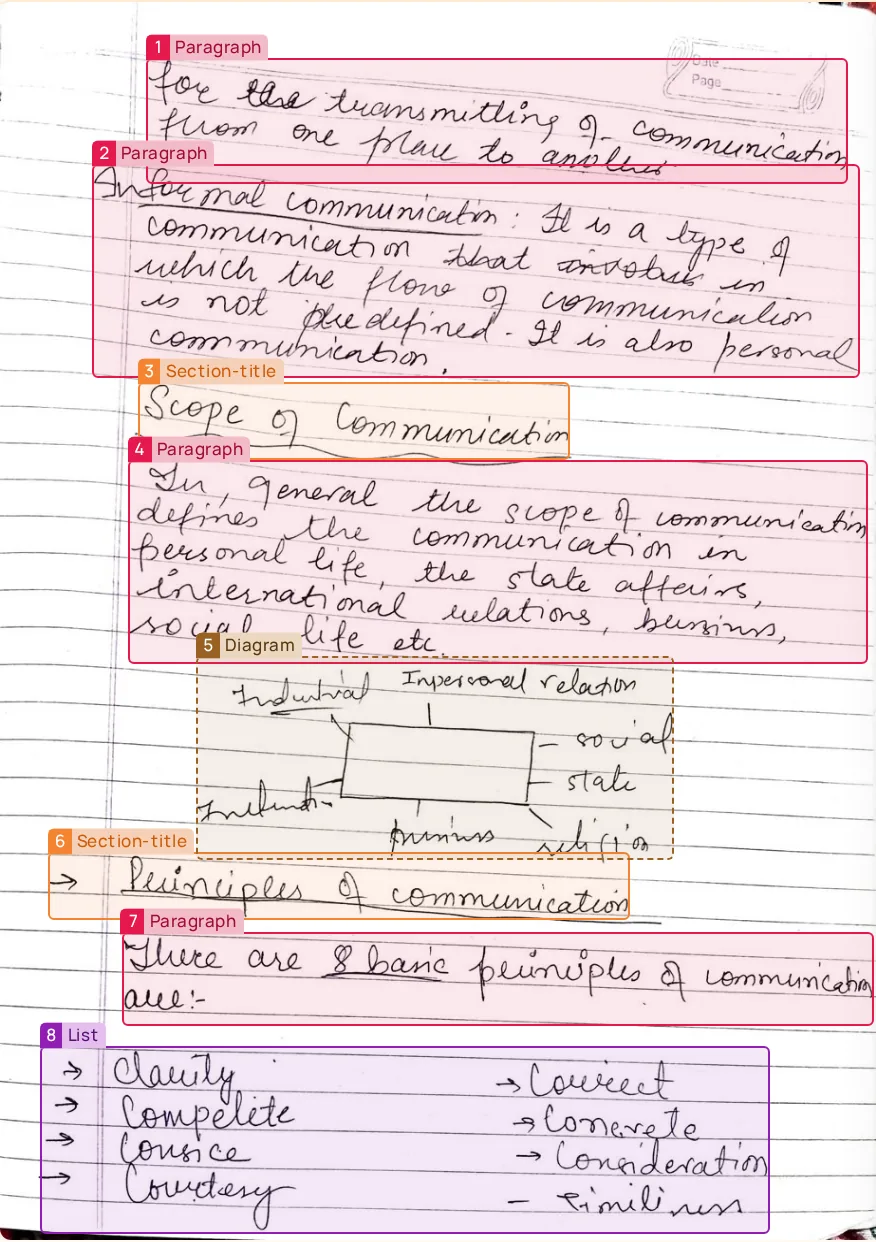
When a teacher grades a handwritten answer sheet, they read it as an answer — not as text. Crossed-out working, a diagram with labels, an equation carried across three lines, a note in the margin: these are all parts of one response. Measuring AI grading accuracy therefore has to go beyond asking "can the model read the pixels?" and ask "can it understand the student's answer?"
That is the question our research at GradeLab set out to answer, and the full study — methodology, samples and results — is published on our AI grading accuracy research page. This post explains what the benchmark measures and why it was built this way.
Student answers are not OCR problems
A real answer sheet can contain hurried handwriting, partially legible words, overwritten characters, arrows, inserted sentences, margin answers, mathematical working, hand-drawn diagrams, tables, multiple pens and continuation across pages — sometimes in more than one language on the same page.
Traditional OCR reads characters. An AI grading system has to understand student answers. Those are different requirements. A single misread exponent or a dropped minus sign can change an expression entirely and flip a correct answer into a wrong one, so recognition fidelity is not a nice-to-have in this domain — it is the grade.
GradeLab uses an agentic document intelligence pipeline: specialized vision and reasoning systems that work together to identify the structure of an answer sheet, interpret its contents, resolve ambiguity, validate uncertain outputs, and convert the page into a structured representation that grading systems can reason over.
The benchmark: 32,587 real assessment images
Existing handwriting benchmarks suffer from two problems: too few high-quality, diverse samples, and evaluations that entangle reading with layout. A model can be penalised for reading text correctly in the wrong order, which says nothing about whether grading would have failed.
So GradeLab built its own internal benchmark that separates the two, evaluating recognition at the block level:
- 22,043 printed images, balanced over all supported languages, covering structured academic documents, tables and mathematical content.
- 10,544 handwritten images, balanced across supported handwriting languages, hand-picked to span a wide range of writers — from school students to adults — and a wide range of conditions: hurried scribbles, bleedthrough, faded text and degraded historical scans.
Word-level accuracy is reported as 100 × (1 − WER) — the standard word error rate inverted — so higher is better and the metric is comparable across models and languages. In other words, this is a handwriting OCR benchmark that measures OCR accuracy where it matters for grading: block by block, language by language. The benchmark includes genuinely hard samples: children's handwriting, messy cursive notes, hand-drawn tables and historical documents, all of which you can see rendered live on the research page.
Three dimensions of grading accuracy
Reading the characters is only the first third of the problem. GradeLab's evaluation framework measures the complete assessment workflow across three dimensions:
- Recognition accuracy — can the content be read correctly?
- Structure accuracy — were questions, answers, equations and diagrams identified correctly?
- Association accuracy — was each response connected to the correct question?
The distinction matters in practice. A system can transcribe every word perfectly and still associate a student's answer with the wrong question, producing a confidently wrong grade. Or it can read an equation but lose the fraction bar, turning a correct derivation into nonsense. A benchmark that only measures transcription cannot see either failure. Ours does.
What the pipeline preserves
Because the goal is grading rather than transcription, the pipeline treats several things as first-class outputs rather than OCR edge cases:
- Mathematics — preserved as LaTeX with spatial relationships intact: fractions, superscripts, subscripts, derivations and scientific notation survive into the structured representation.
- Tables — nested rows and columns keep their structure, so a rubric that grades a lab result or financial calculation can depend on the right cells being in the right places.
- Diagrams — in physics, engineering, biology, chemistry, mathematics and computer science, the answer may depend partly or entirely on a diagram. GradeLab identifies and preserves diagrams alongside the surrounding text and reasoning.
- Mixed languages — a student might write an explanation in their local language while using English technical terminology and mathematical notation on the same page. GradeLab treats these as components of one response across 30+ languages and multiple scripts, not as a language classification problem.
The pipeline also self-validates: it can detect when handwriting quality is low, route those regions to more specialized recognition, and cross-check uncertain interpretations through confidence-based re-evaluation before producing the final structured output.
Read the full research
This post covers the methodology; the complete study lives on the AI grading accuracy page, where you can:
- See the full benchmark methodology and word-level accuracy across agentic models
- Browse real scan-and-reconstruction pairs from the handwriting benchmark
- Watch the parsing pipeline process a live answer sheet
- Cite the work (a BibTeX file is available for academic use)
If you want to see how this accuracy translates into grading in a real classroom workflow, book a demo or explore GradeLab's AI grader and pricing.


