

How Exams Become NAAC & NBA Accreditation Evidence? !
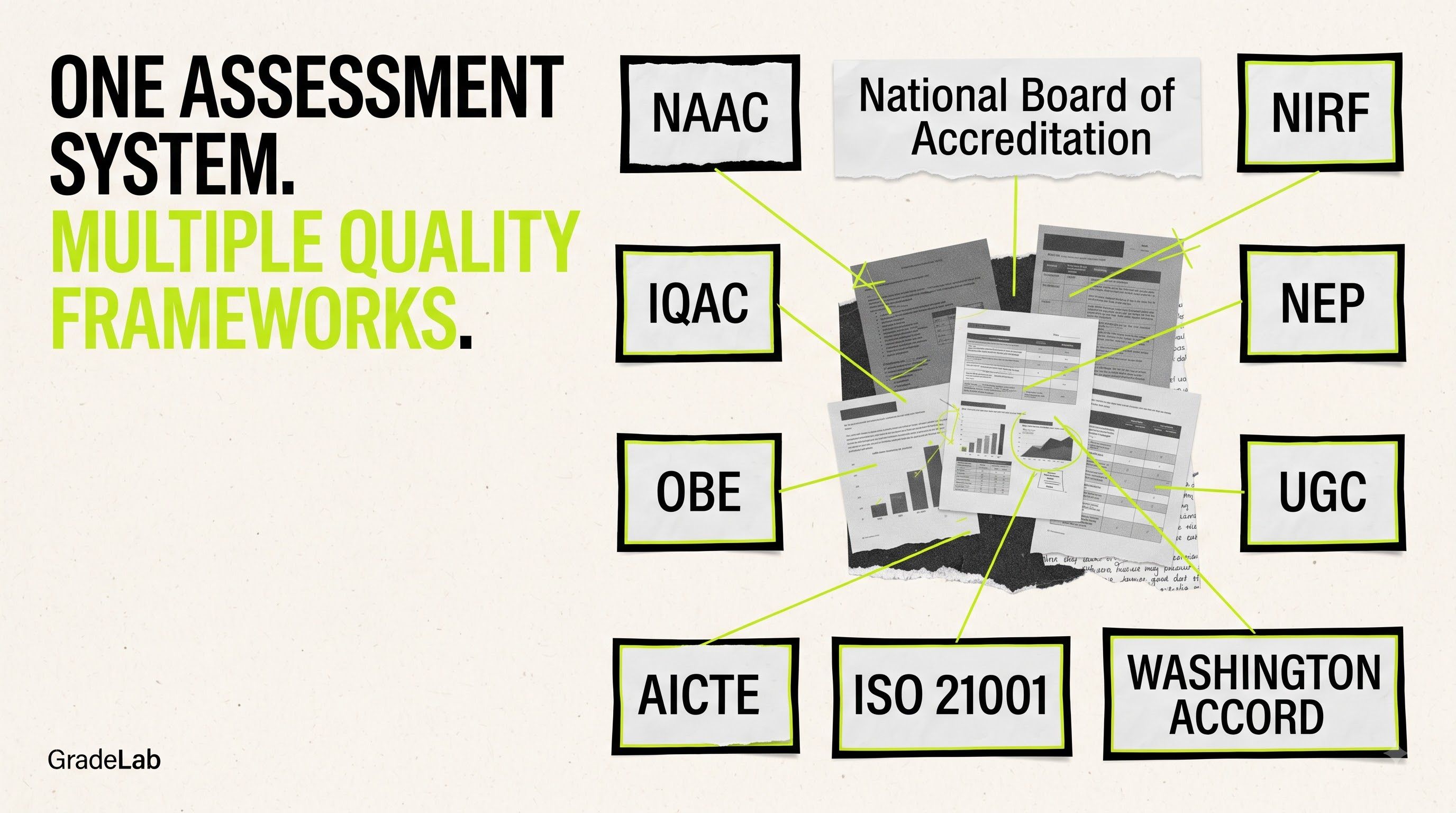
When a NAAC peer team or an NBA visitor arrives, they score records rather than intentions: traceable marks, rubrics actually applied, feedback students received, attainment numbers a department can defend. Every exam already produces this raw material; manual grading rarely preserves it.
TL;DR: NAAC assigns 350 of 1,000 points to Teaching-learning and Evaluation for affiliated colleges, its heaviest criterion (NAAC, Key Indicators and Weightages). Institutions that digitize grading capture rubric-based marks, reviewer actions, and analytics automatically, turning every exam into audit-ready evidence.
What do NAAC and NBA ask institutions to prove?
Teaching-learning and Evaluation is NAAC's highest-weighted criterion across every institution type, rewarding transparent processes, continuous assessment, and feedback students can act on (NAAC framework, naac.gov.in, accessed August 2026).
| Institution type | Criterion 2 points, of 1,000 |
|---|---|
| University | 200 |
| Autonomous college | 300 |
| Affiliated college, UG and PG | 350 |
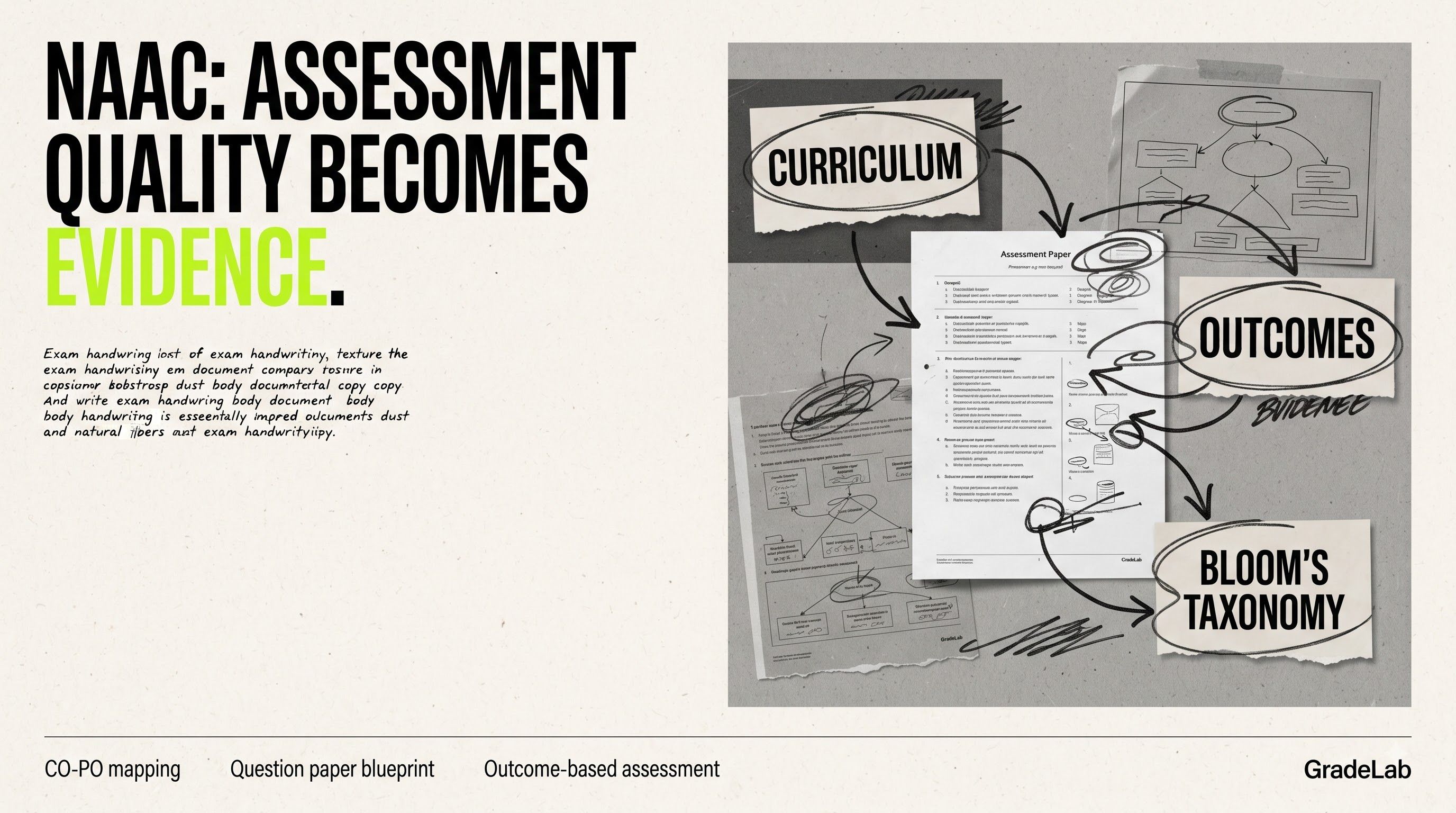
Student Support and Progression adds another 140 points for affiliated undergraduate colleges, much of it tied to measurable outcomes. NBA runs the program-level parallel: its Self-Assessment Report anchors accreditation for engineering, management, pharmacy, and similar programs, a new SAR for undergraduate engineering Tier I took effect on an August 2024 timeline (NBA, nbaind.org), and Tier I status carries Washington Accord recognition abroad.
Both bodies pay for the same thing: documented proof that teaching, marking, and improvement form a working loop.
Where does manual evaluation lose the evidence?
Paper grading destroys the record as it works. Three patterns repeat:
- Inconsistent marking. Two evaluators grade similar answers differently, and without rubric-anchored records nobody can prove otherwise when reviewers probe fairness.